Skip to content

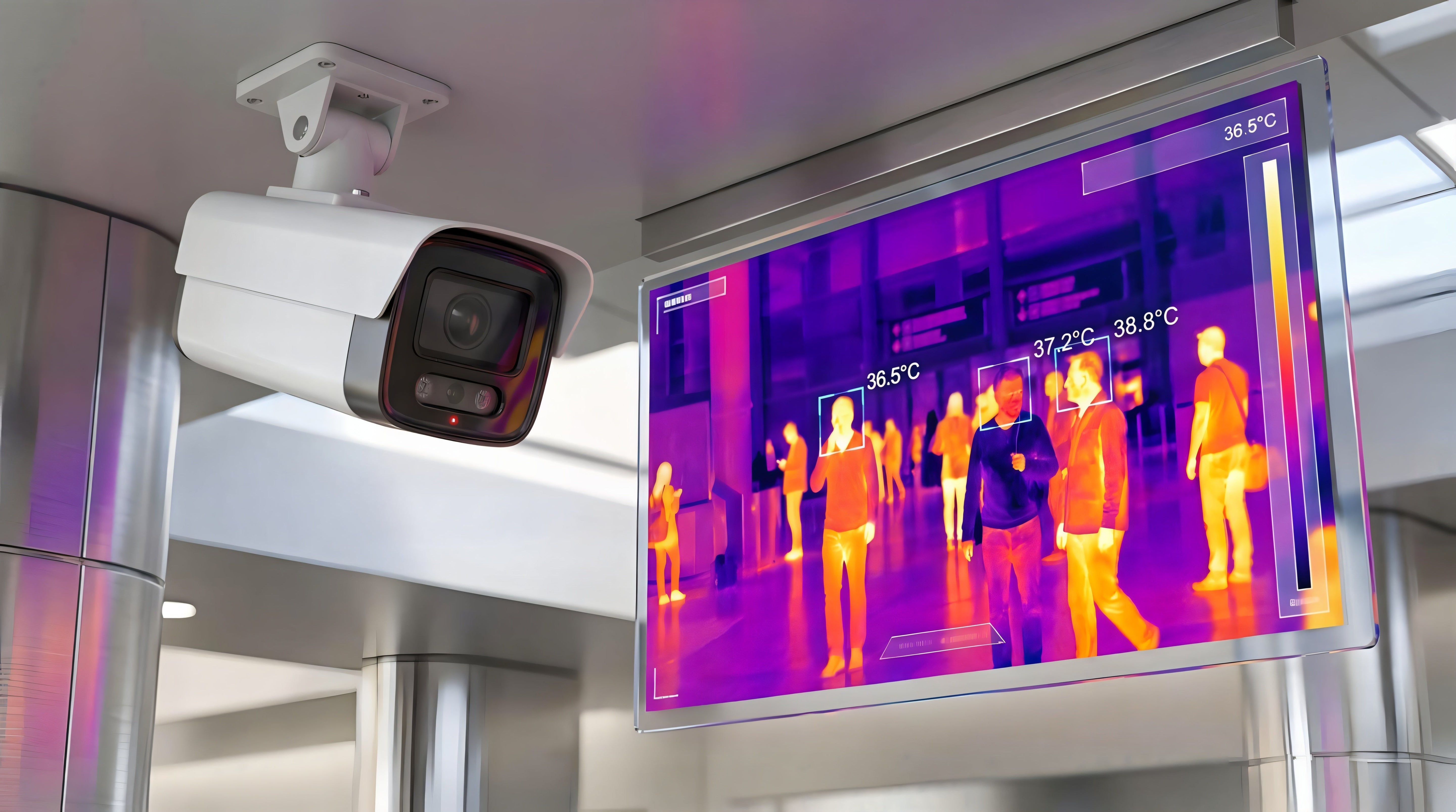
A thermal security camera does one thing no other camera can do. It works when there is no light at all, no headlights, no moon, nothing, and it keeps working through fog, smoke, and the glare that blinds a normal lens at sunrise.
It also cannot tell you who somebody is. That trade sits at the center of every thermal camera decision, and it is the part most buyers find out after the purchase. Here is what thermal actually sees, how far it really reaches, and what a commercial unit costs.
A thermal imager and a thermal security camera are different products
Search for thermal cameras and you will find $200 handhelds at the hardware store sitting next to $7,000 network cameras. They are not competing products and they do not do the same job.
-
A handheld thermal imager is a diagnostic tool. Electricians use one to find a hot breaker, and roofers use one to find damp insulation. You carry it, point it, read it, and put it away. It records nothing on its own.
-
A thermal security camera is a fixed network camera. It mounts on a pole or a wall, streams over the network, records to your recorder, runs analytics, and triggers alarms without anyone holding it. That is what the price difference buys.
If a quote for perimeter security comes back at a few hundred dollars, somebody has priced the wrong category.
What the advertised range actually means
This is the number that causes the most disappointment, and it is worth understanding before you shop. Thermal camera range is quoted in three tiers, and manufacturers advertise the biggest one.
-
Detection: something warm is out there. A shape on the screen, no more than that. This is the number on the spec sheet.
-
Recognition: you can tell it is a person rather than a deer or a car. Typically a fraction of the detection distance.
-
Identification: you can say which person. Often five times shorter than the detection range, sometimes worse.
So a camera advertised at 2,000 feet may detect a warm body that far out, tell you it is human at maybe 600 feet, and never identify anyone at all. Plan the camera around the distance where you need to make a decision, not the distance where the screen shows a smudge.
Thermal gives you the alarm, optical gives you the evidence
Heat has no face. A thermal image will not show you hair color, clothing, a license plate, or a company logo on a van. For an arrest or an insurance claim, that matters.
This is why dual-spectrum cameras exist, and why they have become the sensible default for most perimeter jobs. The UNV TIC3612SA-F7-4F6AC-I1 puts a 4MP optical sensor and a thermal module in one turret housing at $1,779. A 7mm thermal lens and a 6mm optical lens stream as two video feeds under a single IP address. The thermal side spots the intruder in the dark and the optical side records what they look like. Built-in red and blue strobes and a speaker warn them off before anything happens. Comparable options sit in our IP camera collection and the wider video surveillance range.
Radiometric or not, and why it changes the use case
Not every thermal camera measures temperature. Most only show relative heat, which is fine for spotting a person against a cold field. A radiometric camera reads an actual temperature value for every pixel, which opens a different job entirely.
The Hanwha Vision TNO-4030TR is a radiometric thermal bullet at $7,439.99, with a VGA thermal sensor of 640 by 480 pixels. It lets you draw an area or a spot on the image and alarm on average, minimum, or maximum temperature. That turns the camera into fire prevention and equipment monitoring: a bearing running hot in a warehouse, a battery bank starting to climb, a waste pile starting to smolder. The same model with a 19mm lens instead of 13mm costs the same money and simply trades field of view for reach.
If you only need to know that somebody crossed the fence line, you do not need radiometric. If you need to know that something is getting dangerously hot, a radiometric camera is the tool that tells you.
Thermal vs. infrared night vision
|
What you are comparing |
Infrared night vision camera |
Thermal camera |
|
How it sees |
Illuminates the scene with IR light |
Reads emitted heat, no light needed |
|
Total darkness |
Works within the IR range |
Works at any distance the lens covers |
|
Fog, smoke, heavy rain |
IR reflects back and washes out |
Sees through most of it |
|
Sunrise and headlight glare |
Blinded |
Unaffected |
|
Identifying a face or plate |
Yes, in range |
No |
|
Typical false alarms |
Shadows, rain, moving foliage |
Far fewer, heat is a real signal |
|
Camouflage and foliage |
Hides an intruder |
Body heat still shows |
Where thermal cameras are worth the price
Thermal is expensive per camera, so it belongs where cheaper cameras keep failing.
-
Large unlit perimeters: yards, substations, solar farms, and construction sites where lighting the whole fence line would cost more than the cameras.
-
Sites drowning in false alarms: rain, spiders on the lens, and swaying branches trigger motion analytics all night. Heat does not. Cutting nuisance alerts is often the real return.
-
Coastal and industrial fog: ports, marinas, and river sites where an optical camera is useless for hours at a time.
-
Fire risk areas: recycling yards, battery storage, and warehouses, where a radiometric camera catches a temperature rise before there is any smoke to see.
-
Long approach roads: detecting a vehicle or a person while they are still far away buys response time, which is worth more than a sharp picture taken too late.
One place thermal does not belong is indoors and under light. For a shop doorway, a hallway, or a lit parking bay, a good Power over Ethernet camera system does more for less. Our guide to choosing a security camera walks through those cases. The perimeter detection range covers the sensors that usually sit alongside thermal on a fence line.
Three things thermal cannot do
Worth being blunt about these, because they come up in every project.
-
It cannot see through glass. Ordinary window glass blocks the wavelengths a thermal camera reads. Point one at a window and you get a reflection of the room, not the person behind it. Indoor cameras looking out through glazing are wasted money.
-
It cannot see through walls. The camera reads surface heat. A warm patch on a wall means the wall is warm, which is a long way from seeing what is on the other side.
-
Its resolution is small by camera standards. VGA, meaning 640 by 480 pixels, is a high-end thermal sensor. Next to a 4K optical camera that number looks absurd, but thermal detail comes from temperature contrast rather than pixels, so judge it on range and sensitivity instead.
What thermal security cameras cost
Prices spread wider than any other camera category, and the spread is driven by sensor resolution, lens length, and whether the unit measures real temperatures.
-
Entry-level fixed thermal, roughly $870 to $1,300: single-sensor bullets and turrets from the volume brands. Enough for a short fence run or a gate approach.
-
Dual-spectrum, around $1,800: the UNV TIC3612SA lands at $1,779 with thermal, 4MP optical, strobes and a speaker in one housing. For most commercial perimeters this is the sweet spot, because one camera covers both detection and evidence.
-
Radiometric VGA, around $7,400: the Hanwha TNO-4030TR and TNO-4040TR both sit at $7,439.99, buying you real temperature measurement, alarming on defined areas and spots, and 30fps at full resolution.
-
Thermal PTZ, $3,500 to $19,000: pan, tilt and zoom units for covering a wide site from a single mast. Justified when one operator watches a lot of ground.
Budget for the rest of the chain as well. Thermal streams still need recorder capacity, a PoE switch, and mounting that holds steady in wind, since a long lens magnifies every vibration. If the site sells to government or public sector buyers, confirm National Defense Authorization Act (NDAA) compliance rules before ordering anything.
Frequently asked questions
How far can a thermal security camera see?
Further than it can usefully tell you anything. Range is quoted in three tiers: detection, where a warm shape appears, recognition, where you can tell a person from a vehicle, and identification, where you know who it is. Identification is often five times shorter than the advertised detection range. A camera rated to detect at 2,000 feet may only recognize a human at a few hundred, so size the lens around the distance where you need to act.
What are the disadvantages of thermal cameras?
Three main ones. They cannot identify anybody, because heat carries no face, plate or clothing detail. They cannot see through glass or walls, since ordinary glazing blocks the wavelengths they read. And they cost several times more than an optical camera, with commercial units running from roughly $870 for a basic fixed thermal to $7,439.99 for a radiometric VGA model.
Do thermal cameras work in complete darkness?
Yes, and darkness makes no difference to them at all. A thermal camera reads heat emitted by objects rather than light reflected off them, so it needs no illumination of any kind. That is the main difference from an infrared night vision camera, which throws its own IR light onto the scene and only works as far as that light reaches.
What is a radiometric thermal camera?
A radiometric camera measures an actual temperature value for every pixel rather than showing only relative heat. That lets you draw a zone or a spot on the image and raise an alarm on its average, minimum or maximum temperature. The Hanwha Vision TNO-4030TR is a VGA radiometric bullet at $7,439.99 and is used for fire prevention and equipment monitoring as much as for intrusion.
Is a thermal camera better than a regular security camera?
For detection in the dark, in fog, or against glare, yes. For knowing who did it, no. Many commercial sites pair the two, either as separate cameras or in a dual-spectrum unit. The UNV TIC3612SA at $1,779 runs a thermal module and a 4MPoptical sensor as two streams from one IP address. Thermal raises the alarm and optical produces the evidence.
How much does a thermal security camera cost?
Fixed commercial thermal cameras start around $870 and run to about $1,300. Dual-spectrum models that add an optical sensor sit near $1,800. Radiometric VGA cameras that measure real temperature are around $7,400, and thermal PTZ units range from roughly $3,500 to $19,000. Handheld thermal imagers costing $200 to $400 are diagnostic tools and are not security cameras.
Buy thermal for the dark half of the problem
Thermal is not a better camera. It is a different sensor that solves the part of the job normal cameras keep failing: seeing something at all when there is no light, no visibility, or too much glare. Pair it with an optical sensor so you still get a usable image. Size the lens around the distance where you need to make a decision. Then put the money where cheap cameras have already proven they cannot cope.