Skip to content

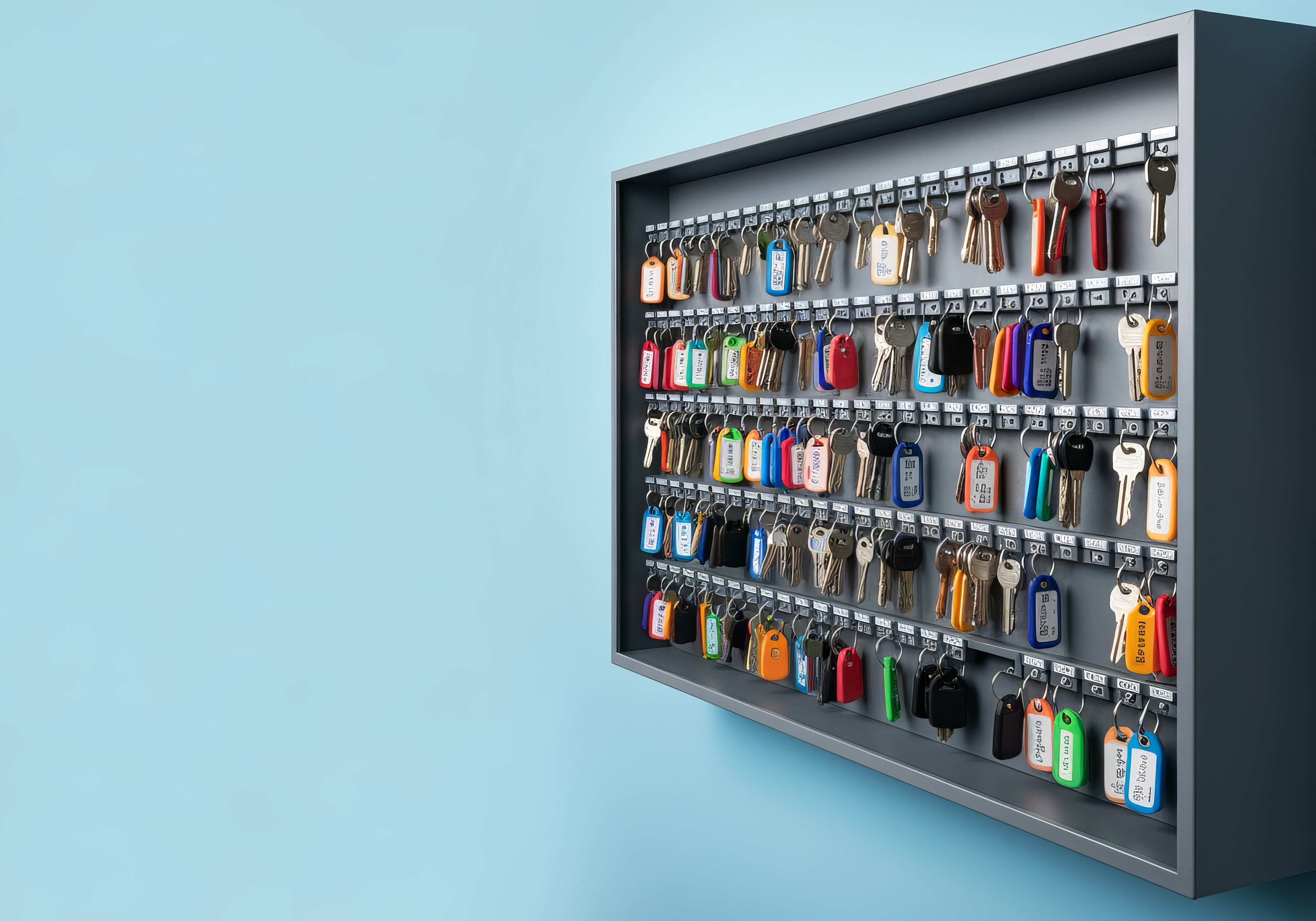
Every business has spent money on locks and then handed out the keys with no record of who has what. Physical keys are the one credential nobody manages. They get copied at a hardware store for four dollars, they leave with people who quit, and losing a single master means rekeying a building.
A key control cabinet is the cheapest fix in commercial security, and most businesses buy the wrong one. Here is how to size it, which lock to put on it, what it costs, and when an electronic key management system is genuinely worth the jump in price.
A cabinet stores keys and key control tracks them.
These get treated as the same purchase and they are not. The cabinet is hardware. Key control is a process that says who may take which key, who signed for it, and when it came back.
A locked box on the wall with fifty unlabeled keys inside is storage, and it fails the moment somebody asks which key opened the back door last Tuesday. Buy the cabinet, then write the process. Skip the second step and the keys still go missing, just more tidily.
Sizing: how many positions you actually need
Undersizing is the most common mistake, and there is no way to expand a cabinet once it is full. Count properly before you buy.
-
Count every key, not every lock: one door might have three keys in circulation. All three need a hook.
-
Add the spares: most sites keep at least one duplicate per lock, and the duplicates are exactly what the cabinet is for.
-
Add vehicle and equipment keys: fleet keys, forklift keys, padlock keys, and cabinet keys pile up faster than door keys do.
-
Then add 30 percent: the cabinet outlives several rounds of tenants, vehicles and locks. Buying the next size up costs a few dollars now and saves buying twice.
One practical note on layout. Adjustable-hook cabinets let you move the rails and fit long keys, remotes, and fobs on rings. Fixed-hook models pack in more positions for the same wall space but will not take anything bulky. If your keys live on rings with a car remote attached, buy adjustable.
The lock on the cabinet decides everything
There is an obvious problem with securing keys behind a key. Somebody has to carry that one, it can be copied like any other, and it records nothing. The lock you choose is really a choice about accountability.
|
Cabinet lock |
What it gives you |
What it does not |
|
Key lock |
Lowest cost, nothing to power or program |
One more key to control, no record of who opened it |
|
Combination dial |
No key to lose, easy to hand over at shift change |
Everyone shares one code, so nobody is accountable |
|
Digital keypad |
Multiple user codes, quick to change when staff leave |
Codes get shared unless you audit them |
|
RFID card |
One credential per person, cards revoked individually |
Cards can be handed to a colleague |
|
Full electronic system |
Per-key release, automatic logging, alerts on overdue keys |
Costs several times more and needs setup |
The jump that matters is from a shared secret to an individual credential. A keypad with one code for the whole team is only marginally better than a key. A keypad with a code per person, or a reader that takes an RFID card like a door fob, is the point at which the cabinet starts producing useful information. If you already run credentials for your doors, it is worth checking whether the same cards can open the cabinet.
What key control cabinets cost
Prices are driven by capacity and by the lock, and the two do not scale together. Here is roughly where the money goes.
-
Key-lock cabinets, $80 to $110 for 42 to 90 positions: the Barska 42, 50, 64 and 90 position models all sit in this band. At small sizes, capacity barely moves the price.
-
Combination and digital, $190 to $450 for 48 to 300 positions: a 48-key digital wall safe runs $192.59 and a 100-key model $257.39. Adjustable combination cabinets are $197.99 for 100 keys and $378.89 for 300.
-
RFID, $313.19 for 200 keys: the Barska 200 Keys Adjustable Key Cabinet with RFID Lock gives every person their own card at a price close to a plain combination cabinet. Spare cards are $14.39 for five.
-
High capacity, $490 to $1,400: 480, 600 and 800 position key-lock cabinets, plus a 736-key keypad model at $1,026.89 for sites that need both scale and codes.
Add key tags while you are at it. Fifty assorted tags cost $13.49 and a hundred small ones $22.49, and an untagged cabinet is a drawer of mystery metal. All of these sit in our security safes and cabinets range.
When you need a full electronic key management system
Intelligent key systems release one specific key to one authenticated person, log it automatically, and alert you when a key is overdue. They are genuinely good. They also start north of $1,200 and run past $13,000 for large electronic cabinets, which is ten to forty times the price of a good RFID cabinet.
Most businesses do not need one, and every vendor page you will read is written by somebody who sells them. The honest test is whether you can answer yes to at least two of these.
-
High key turnover: keys move several times a day, every day, and a paper log would never keep up. Dealerships, valet operations and large fleets qualify. A dental practice with eleven keys does not.
-
Real financial exposure per key: a key that opens a vehicle worth $40,000 or a controlled drug cabinet justifies automatic logging. A key to a supply closet does not.
-
An audit or insurance requirement: if somebody external will ask for a key access report, you want the system to produce it rather than a person.
-
Nobody owns the process: if there is no person who will police a signout sheet, automation is the only thing that will hold. This is the most honest reason to spend the money.
If none of that applies, an RFID or keypad cabinet plus a written policy will do the same job for a few hundred dollars. Dealerships are the clearest case where the upgrade pays, and we covered that scenario in detail in our guide to key cabinets for car dealerships.
The process that makes any cabinet work
Hardware is the easy half. Five habits turn a locked box into actual key control.
-
Tag and number every key. Tag, hook number, and a master list that maps numbers to doors. Never write the door name on the tag, since a lost key should not come with directions.
-
Name one owner. One person is responsible for the cabinet, the codes and the list. Shared ownership means no ownership.
-
Log the return as well as the checkout. Most sheets record who took a key and never record it coming back, which is the half that matters.
-
Audit monthly. Ten minutes counting hooks against the list will find the missing key while you can still remember who had it.
-
Change the code when people leave. Put it on the offboarding checklist beside the laptop and the badge. It is the step everybody forgets, and it is the reason old codes still work.
Keys sit at the bottom of every other security investment. A building with excellent physical access control on the doors and a shared key cabinet in the back office has a very expensive front door and an open back one. The same logic applies to cash: our guide to depository and drop safes covers the equivalent problem for money, and the full safes range sits alongside the key cabinets.
Frequently asked questions
What is an electronic key management system?
It is a cabinet that releases individual keys only to authenticated users and records every transaction automatically. A person identifies themselves with a code, a card, or a fingerprint. The system then releases only the keys they are authorized to take, logging who took what and when it came back. Prices start around $1,200 and reach past $13,000 for large electronic cabinets, compared with roughly $313 for an RFID key cabinet holding 200 keys.
How many keys should a key cabinet hold?
Count every key in circulation rather than every lock, add your duplicates, add vehicle and equipment keys, then add about 30 percent for growth. Cabinets cannot be expanded, so the extra capacity is cheap insurance. At the small end capacity barely affects price anyway: the Barska 42, 50, 64 and 90 position cabinets all cost between $80.99 and $107.09.
How much does a key control cabinet cost?
Key-lock cabinets holding 42 to 90 keys run $80.99 to $107.09. Digital and combination models holding 48 to 300 keys run $192.59 to $449.09. A 200-key RFID cabinet is $313.19. High capacity units reach $1,399.49 for 800 positions, and a 736-key keypad model is $1,026.89. Key tags add $13.49 for fifty.
What is the difference between a key safe and a key cabinet?
A key cabinet is built for organization and holds many keys on numbered hooks behind a light steel door. A key safe is built for protection, with a heavier body and a proper lock, and usually holds fewer keys. If your risk is people borrowing keys without asking, a cabinet is right. If your risk is somebody prying the box off the wall overnight, buy the safe.
Are RFID key cabinets worth it over a keypad?
Usually yes, and the price gap is smaller than people expect. A keypad gives you codes that get shared and written on sticky notes. An RFID cabinet gives every person a card that can be revoked on its own, which is what turns the access log into something you can trust. The Barska 200-key RFID cabinet is $313.19 with spare cards at $14.39 for five, close to what a plain combination cabinet of similar capacity costs.
How do you keep track of who has a key?
Number every hook, tag every key with that number, and keep a master list that maps numbers to doors without naming the door on the tag itself. Record both the checkout and the return, name one person as owner of the cabinet, audit the hooks against the list monthly, and change the code whenever somebody leaves. An electronic key management system does all of this automatically, which is its real value over a cheaper cabinet.
Buy the cabinet, then write the policy
Key control is the rare security problem where a few hundred dollars fixes most of it. Size the cabinet for the keys you will have in three years. Choose a lock that gives each person their own credential rather than a shared code, tag everything,and put one person in charge. Step up to a full electronic system when key volume or the value behind each key makes manual logging unrealistic, and not because a brochure said so.