Skip to content


A locked front door does very little for a building where anyone standing in the lobby can ride to any floor they like. That is the gap an elevator access control system fills, and in a multi-tenant building it is usually the last piece anyone thinks about.
The technology itself is simple. The install is where projects go sideways. An elevator belongs to a different contractor and answers to a different code. Most of its cost hides in wiring you cannot see from the lobby. Here is how the systems work, what the hardware costs, and the three things that catch buildings out.
What elevator access control actually controls
Three different jobs get sold under the same name, and they are not interchangeable.
-
Hall call control: a reader in the lobby decides whether the elevator comes at all. It is the cheapest version and the weakest. Once anyone calls the car, everybody standing there rides it.
-
Floor selection control: a reader inside the cab decides which floor buttons work. Badge in and your floors light up while the rest stay dead. This is what people mean by floor-by-floor security, and it is the version that holds up in a building with several tenants.
-
Destination dispatch: you enter your floor at a lobby terminal and the building assigns you a car. Common in newer high rises, and the access rules live inside the elevator manufacturer's own software rather than yours.
For a 4 to 12 story building with mixed tenants, floor selection control is almost always the right answer. It is also the one that needs the most thought about wiring, which is the next section.
The two ways to wire it into the elevator
Everything comes down to whether you interrupt the buttons or talk to the elevator's brain.
-
Relay control, also called a low-level interface: the access panel provides one dry contact relay per floor, wired in series with that floor's button circuit. Present a valid credential and your relays close, so your buttons respond. It works with almost any elevator whatever its age or brand, and your security integrator owns the whole chain.
-
High-level interface: the access system speaks to the elevator controller over a serial or network link instead of cutting into button circuits. Cleaner, and mandatory if the building runs destination dispatch, because there is no button to interrupt. There is a catch. You need the elevator manufacturer's interface, it is a paid option, and it ties the building to them.
On a retrofit, relay control usually wins on both price and independence. A high-level interface earns its cost on new construction, when the elevator is being commissioned anyway and the engineering is already on the table.
Relay control vs. high-level interface
|
What you are comparing |
Relay control |
High-level interface |
|
How it connects |
One dry contact per floor, in series with the button |
Serial or network link to the elevator controller |
|
Works with older elevators |
Yes, nearly any make |
Only if the maker offers an interface |
|
Who supplies it |
Your security integrator |
The elevator manufacturer, as a paid option |
|
Destination dispatch |
Not supported |
Required |
|
Main cost driver |
Relay boards, one block per eight floors |
Interface license plus elevator engineering time |
|
Tied to one vendor |
No |
Yes |
Floors are sold in blocks of eight
Elevator control hardware is priced by the block, not by the floor, and the block is almost always eight. That one detail shapes a budget more than the brand does, and it is the number to check before you quote anything.
-
Aiphone AC Series Elevator Starter Kit, $2,031.99: covers one cab and eight floors out of the box. You get the elevator master controller, an AC-2DE expander with two card reader inputs and four solid-state dry contact relays, one AC-IOE floor expander, and the enclosure. Each extra AC-IOE board adds eight more floors, up to seven boards for 64 floors on a single cab or 32 floors across two.
-
Linear eMerge Elite Elevator Access Control Module, $668.99: adds eight floors to an eMerge E3 or Elite-36 system that is already installed. If the building runs eMerge, this is much the cheaper route.
-
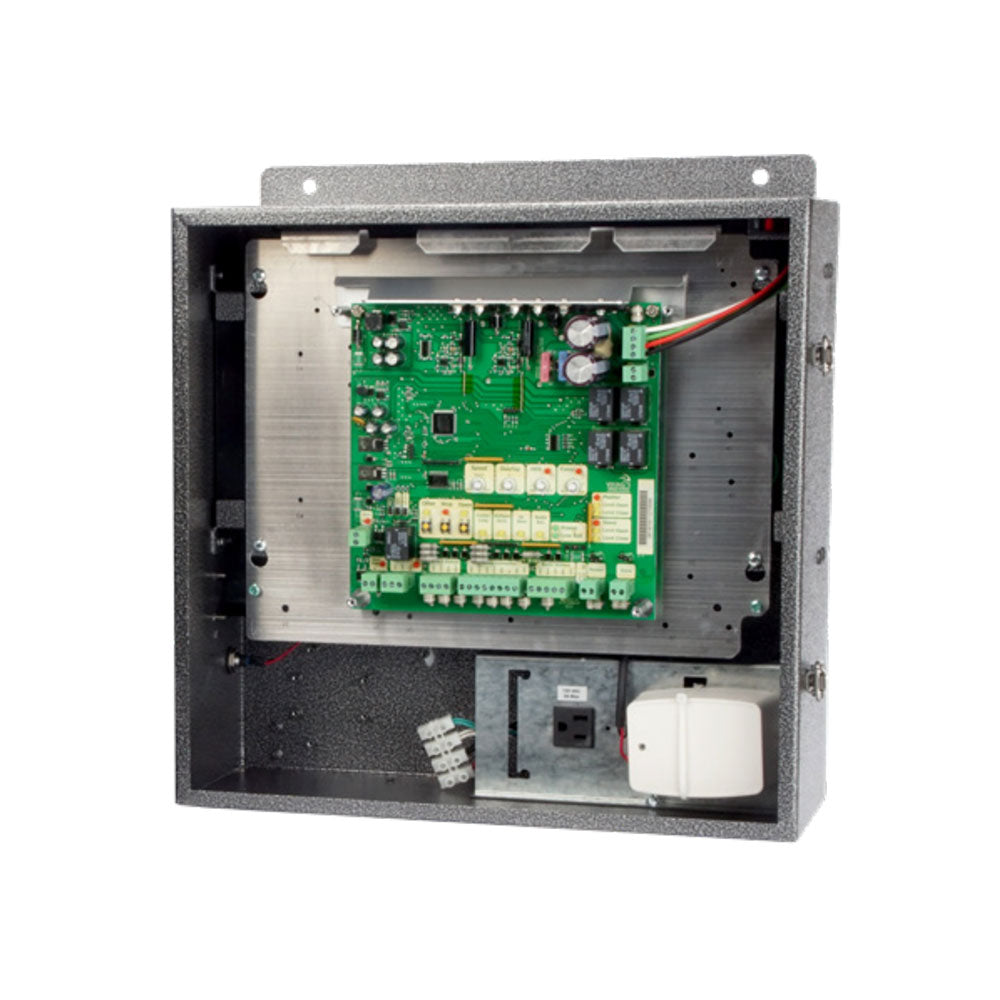
Linear eMerge Elite elevator nodes, $974.99 and $1,225.99: standalone expansion nodes for elevator control, the first in a compact plastic enclosure and the second in a locking metal cabinet. Both carry a tamper switch.
Do the arithmetic before you promise a price. A nine story building needs two blocks, and so does a sixteen story one, which means nine floors costs the same as sixteen. If floor nine is a mechanical level nobody badges to, leaving it out of the controlled list saves an entire board. Check the power supply too. The Aiphone kit needs an AC-PS1267 that does not come in the box. Full ranges for both brands sit in our Aiphone collection and Linear collection.
Where the reader goes, and the cable nobody budgets for
Floor selection means the reader sits inside the cab, next to the buttons it controls. Getting it there is the part that surprises people.
Wiring from a cab reader has to travel through the traveling cable, the umbilical that connects the moving car to the hoistway. If that cable has spare conductors, the job is short. If it does not, the whole cable gets replaced. Only the elevator contractor is allowed to do that work. Ask for a spare conductor count before anyone signs anything. It is the single most common reason an elevator access job lands over budget.
Lobby readers dodge the cable entirely, which is exactly why hall call control looks so cheap on paper. It also cannot stop a resident from riding to a floor that is not theirs. Wherever the reader ends up, mount it within reach of someone using a wheelchair and clear of the car operating panel. Your credential choice matters here as well, since a reader in a cab gets touched hundreds of times a day. Our fobs and cards collection covers the usual options, and the tradeoffs are laid out in our guide to mobile credentials versus key cards.
Fire service always wins
Access control sits on top of the elevator, never underneath it. That is not a preference, it is code. Fire service operation has to work no matter what the access system believes about who is standing in the car.
-
Recall takes priority. When emergency recall is triggered, the car returns to its designated landing and opens the doors. Credentials do not enter into it.
-
Firefighters reach every floor. Once a firefighter is operating the car from inside, every floor has to be available, whether or not it is enabled for anybody else.
-
Fail in the safe direction. Design the relays so a dead access panel leaves the buttons working. A building where a blown power supply strands people between floors is a building with a much bigger problem than tailgating.
Your elevator contractor and the local inspector will test all of this at handover. Plan for it rather than discovering it on inspection day.
Who owns which part of the job
Elevator projects stall over scope far more often than over technology. The line sits in a predictable place.
The elevator contractor owns the machine room, the controller, the traveling cable and everything inside the hoistway. Nobody else touches any of it, and most maintenance contracts say so in writing. Your security integrator owns the readers, the access panel, the credentials and the software. The wire between those two worlds is where jobs get stuck.
Agree in writing who pulls that wire, who terminates it, and who pays for the elevator contractor's time on site, because they will bill for it. Get their interface pricing early too. On a high-level interface job that quote can take weeks to arrive and can move the budget enough to change the design. If you are specifying the wider system at the same time, our access control range and the physical access control guide cover the doors and panels the elevator ties back into.
Frequently asked questions
What is an elevator access control system?
It is a set of readers, a controller and relays. Together they decide who can call an elevator and which floors that person can select once inside. A credential is presented at a reader, the controller checks it, and only the floor buttons that person is allowed to use will respond. Every attempt is logged with a time, a floor and a credential, which is what makes it useful in a building with several tenants.
How much does elevator access control cost?
Hardware for one cab and eight floors starts around $2,032 with the Aiphone ACSeries Elevator Starter Kit. That bundles the master controller, a two-reader expander with four relays, a floor expander and the enclosure. Adding eight floors to an existing Linear eMerge system costs $668.99, and standalone Linear elevator nodes run $974.99 to $1,225.99. Budget separately for the power supply, the readers and credentials, and the elevator contractor's labor, which is often the largest single line on the quote.
Can you add access control to an existing elevator?
Yes, and relay control is the usual way to do it. Because the relays simply sit in series with the existing floor button circuits, the method works with almost any elevator regardless of age or manufacturer. The one thing to confirm first is whether the traveling cable has spare conductors for the cab reader. If it does not, the cable has to be replaced by the elevator contractor, and that changes the budget considerably.
What is the difference between hall call control and floor-by-floor control?
Hall call control puts the reader in the lobby and decides whether the elevator responds to a call. Floor-by-floor control, also called floor selection or car station control, puts the reader inside the cab and decides which floor buttons work for that person. Hall call is cheaper because it avoids the traveling cable, but it stops nobody once the car has been called by someone else.
Does elevator access control affect fire service operation?
It must not. Emergency recall sends the car to its designated landing with the doors open,regardless of any credential. A firefighter operating the car from inside has to reach every floor in the building. Access control is designed to release entirely when fire service operation is active, and both your elevator contractor and the local inspector will test that behavior before the system is signed off.
How many floors can one elevator access control panel handle?
Capacity is sold in blocks of eight floors. The Aiphone AC Series kit covers eight floors on one cab as supplied. AC-IOEboards expand it to a maximum of 64 floors on a single cab, or 32 floors across two. The Linear eMerge elevator module also adds eight floors at a time. Because you buy whole blocks, a nine story building pays the same hardware cost as a sixteen story one.
Three questions set the elevator budget
Elevator access control is cheap technology wrapped in an expensive install, and the budget lives in three questions. How many blocks of eight floors do you actually need to control? Does the traveling cable have spare conductors? And who is paying the elevator contractor to be on site? Answer those three before you compare brands, and the rest of the project is straightforward.