Skip to content

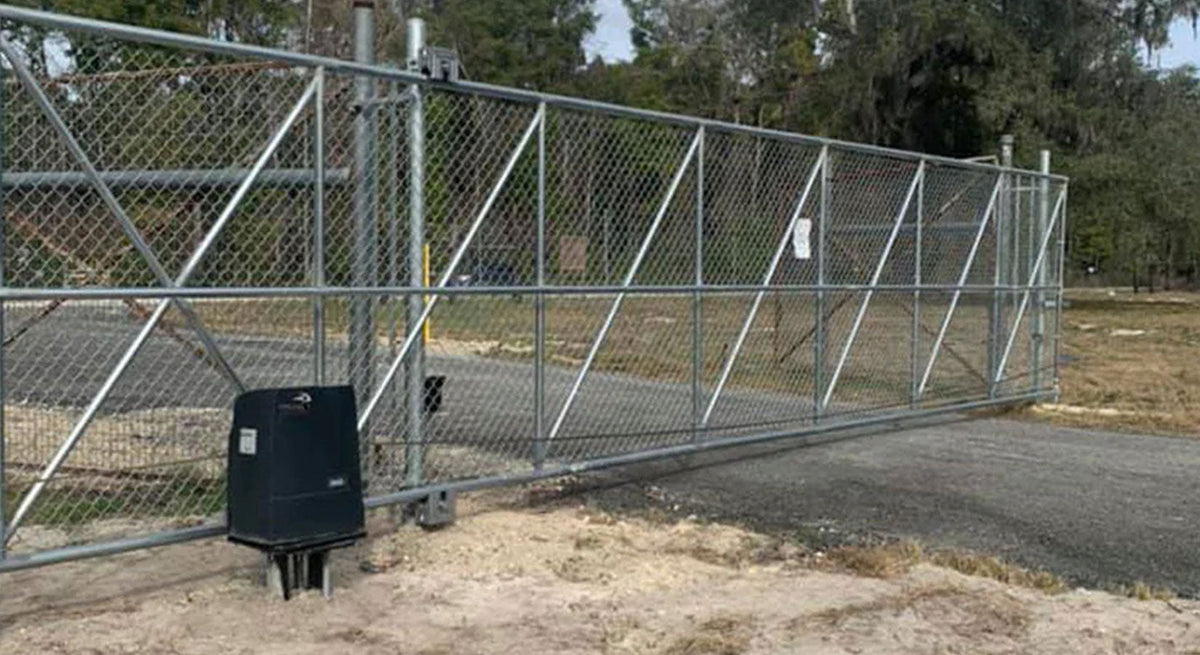
When choosing a sliding gate system, one of the biggest decisions is whether the gate will travel on a ground track or use a cantilever design.
Both systems move horizontally along the fence line and can be automated with a slide gate operator, but the way they support and move the gate is very different.
A traditional tracked sliding gate rolls along a track installed across the opening. A cantilever gate, on the other hand, is supported by a roller system and remains suspended above the driveway as it opens and closes.
That difference affects everything from gate construction and hardware to installation space, maintenance, and site conditions.
So, which option is right for your project?
In this guide, All Security Equipment explains the differences between cantilever and tracked sliding gates, the hardware each system requires, and what to consider when adding automatic gate operation.
What Is a Sliding Gate?
A sliding gate moves horizontally rather than swinging inward or outward.
When the gate opens, it travels alongside the fence or property line.
This makes slide gates especially useful where there isn’t enough room for a swing gate to rotate through the driveway.
Common applications include:
- Commercial properties
- Industrial facilities
- Warehouses
- Gated communities
- Apartment complexes
- Parking facilities
- Residential driveways
- Storage facilities
However, not every sliding gate moves the same way.
Two common configurations are:
Tracked sliding gates
and
Cantilever gates
Understanding the difference is important before selecting the gate hardware.
What Is a Tracked Sliding Gate?
A tracked sliding gate is supported by wheels that travel along a track installed at ground level.
Think of it like a rail system.
The basic configuration looks like this:
Gate → Wheels → Ground Track
As the gate opens and closes, the wheels roll along the track across the driveway opening.
Depending on the gate design, components can include:
- V-groove wheels
- Ground track
- Guide rollers
- Gate stops
- Brackets
- Chain hardware
- Slide gate operator
The ground track provides the path that supports and guides the gate as it moves.
Advantages of a Tracked Sliding Gate
Straightforward Operating Principle
The system is relatively easy to understand.
The gate rests on wheels, and the wheels follow a defined track.
Less Counterbalance Space
A tracked gate generally doesn’t require the same extended counterbalance section used by a cantilever gate.
That can be useful on properties where space alongside the fence is limited.
Common Hardware
Tracks, wheels, guide rollers, chains, and related sliding gate components are widely used and available in many configurations.
Potential Challenges
The biggest consideration is the track itself.
Because the track crosses the vehicle opening at ground level, it can be affected by:
- Dirt
- Gravel
- Leaves
- Mud
- Ice
- Snow
- Small stones
- Pavement movement
- Physical damage
Anything that interferes with the wheels or track can affect how smoothly the gate moves.
For that reason, tracked gates may require regular inspection and cleaning, particularly in demanding environments.
What Is a Cantilever Gate?
A cantilever gate also slides horizontally, but there is one major difference:
The gate does not roll on a track across the driveway.
Instead, the gate is supported horizontally by a roller system attached to posts located beside the opening.
The gate remains suspended above the ground as it moves.
The rollers support the gate from the side, allowing it to travel across the opening without requiring a ground track.
This makes cantilever gates especially attractive for locations where keeping the driveway opening clear is important.
How Does a Cantilever Gate Stay Suspended?
At first glance, a cantilever gate can seem unusual.
If there are no wheels underneath the gate in the driveway, what keeps it from falling?
The answer is the counterbalance section and cantilever roller system.
The gate extends beyond the actual driveway opening.
That additional section remains behind the support posts and works with the rollers to support and balance the gate.
As the gate moves, the roller assemblies support the gate structure while allowing it to travel horizontally.
This means a cantilever gate is typically longer than the clear opening it needs to cover.
That extra length is an important consideration when determining whether the property has enough room for a cantilever installation.
Cantilever Gate vs. Tracked Sliding Gate
Here’s a quick comparison:
|
Feature |
Cantilever Gate |
Tracked Sliding Gate |
|---|---|---|
|
Ground track across opening |
No |
Yes |
|
Gate suspended above driveway |
Yes |
No |
|
Ground wheels across opening |
No |
Yes |
|
Counterbalance section |
Required |
Typically not the same extent |
|
Sensitive to debris in track |
Less |
More |
|
Clear driveway surface |
Yes |
Track crosses opening |
|
Space alongside opening |
More required |
Generally less |
|
Can be automated |
Yes |
Yes |
|
Uses slide gate operator |
Typically |
Typically |
|
Specialized support hardware |
Yes |
Track/wheel system |
Neither design is automatically better.
The right choice depends on the property, available space, gate construction, environment, traffic, and installation requirements.
Why Choose a Cantilever Gate?
Cantilever gates solve several practical problems associated with ground tracks.
1. Nothing Runs Across the Driveway
One of the biggest advantages is the clear opening.
There is no gate track running across the vehicle path.
That can be useful at entrances where:
- Heavy vehicles regularly pass through
- Pavement conditions make a track difficult
- Keeping the road surface clear is desirable
- Dirt and debris are common
- Snow or ice may accumulate
The gate remains above the roadway rather than relying on a track installed in it.
2. Less Exposure to Track Obstructions
A small object in a ground track can interfere with a tracked gate.
Cantilever gates eliminate that particular problem because there is no travel track across the opening.
That doesn’t mean cantilever gates are maintenance-free. Rollers, guides, gate structure, hardware, and the operator still require proper inspection and maintenance.
But the system removes one potential source of trouble from the driveway itself.
3. Useful for Uneven or Challenging Surfaces
Installing a straight, properly supported track across certain surfaces can be difficult.
A cantilever design may provide an alternative where a ground track isn’t desirable or practical.
The gate still needs to be engineered and installed correctly, and adequate space and structural support are essential.
4. Good Fit for Busy Entrances
Because the driveway remains free of gate track, cantilever gates are commonly considered for commercial, industrial, and other vehicle entrances.
Applications can include:
- Warehouses
- Distribution facilities
- Industrial properties
- Parking entrances
- Gated communities
- Commercial facilities
Why Choose a Tracked Sliding Gate?
Cantilever gates offer significant advantages, but tracked gates also have their place.
1. Less Gate Length May Be Required
Because a cantilever gate needs an extended counterbalance section, it requires additional space alongside the opening.
A tracked gate doesn’t typically need the same type of extended gate frame.
Where lateral space is limited, this can make a tracked configuration more practical.
2. Familiar Hardware Configuration
Tracked slide gates use a straightforward combination of track, wheels, guides, and related hardware.
For many installations, this can provide a practical and familiar solution.
3. Suitable Where the Ground Surface Allows a Track
If the driveway surface is stable, properly prepared, and easy to keep clear, a tracked gate can work very effectively.
The key is ensuring that the track remains:
- Straight
- Secure
- Clean
- Properly aligned
- Free of obstructions
What Hardware Does a Cantilever Gate Need?
A cantilever gate requires hardware specifically designed to support a suspended sliding gate.
The exact components depend on the gate design and manufacturer, but a system may include:
Cantilever Rollers
Cantilever rollers are among the most important components in the system.
They support the gate and allow it to move horizontally.
Rollers need to be selected according to the gate’s:
- Frame design
- Dimensions
- Weight
- Tube or rail profile
- Installation configuration
Using improperly sized rollers can affect gate alignment, movement, and overall system performance.
Support Posts
The roller assemblies need a strong structural foundation.
Support posts must be positioned and installed correctly to handle the loads created by the suspended gate.
A cantilever gate can place significant forces on these support points, especially as gate length and weight increase.
Guide Rollers
Guide rollers can help maintain gate alignment as the gate travels.
They should guide the gate without creating unnecessary resistance.
Gate Stops
Stops help define the gate’s physical travel and can prevent it from moving beyond its intended position.
Catch or Receiver Hardware
Depending on the gate design, receiving hardware can help support or stabilize the gate when it reaches the closed position.
Operator Hardware
If the gate is automated, additional hardware can include:
- Chain
- Chain brackets
- Operator mounting hardware
- Idlers
- Tensioning components
The exact components depend on the slide gate operator and gate design.
What Hardware Does a Tracked Sliding Gate Need?
A tracked sliding gate uses a different support system.
Typical components can include:
Ground Track
The track creates the path the gate follows across the driveway.
It must be installed straight and securely.
V-Groove Wheels
V-groove wheels ride along compatible V-track and support the gate as it moves.
Wheel capacity should be appropriate for the gate’s weight and application.
Guide Rollers
Guide rollers help keep the gate upright and properly aligned.
Stops and Catch Hardware
These components help control the gate’s physical travel and stabilize it at the end of its movement.
Operator Chain and Brackets
For automated systems, the slide gate operator typically uses a chain connected to the gate through appropriate brackets and hardware.
How Do You Automate a Cantilever Gate?
Cantilever gates can be automated using a compatible slide gate operator.
Although the gate is suspended differently from a tracked gate, the operator still needs to move it horizontally between the open and closed positions.
The operator drives the chain, moving the gate along its cantilever roller system.
The operator should be selected according to factors such as:
- Gate length
- Gate weight
- Daily cycles
- Residential or commercial use
- Opening speed
- Power availability
- Environmental conditions
Do not assume that any slide gate operator can handle any cantilever gate.
Always compare the gate specifications with the operator manufacturer’s approved ratings and installation requirements.
How Do You Automate a Tracked Slide Gate?
A tracked slide gate can also use a chain-driven slide gate operator.
In this case, the operator moves the gate while its wheels travel along the ground track.
A complete automated installation may include:
Slide Gate Operator
Chain and Brackets
Access Control
Vehicle Detection
Entrapment Protection
Power / Battery Backup
The gate itself should move smoothly before the operator is connected.
Automation should never be used to compensate for a damaged wheel, obstructed track, misaligned gate, or other mechanical problem.
Gate Weight Matters, But So Does Rolling Resistance
When selecting a slide gate operator, gate weight is an obvious consideration.
But the operator isn’t lifting the entire gate.
It is moving the gate horizontally.
That makes rolling resistance and mechanical condition extremely important.
A properly installed heavy gate that moves smoothly may place less unnecessary strain on the operator than a lighter gate with:
- Damaged wheels
- Misaligned rollers
- Bent track
- Binding hardware
- Poorly adjusted guides
Before automating either type of slide gate, manually inspect its movement.
The gate should travel smoothly through its full range without excessive resistance.
What About Wind?
Wind is another important consideration, particularly for gates with solid surfaces.
A chain-link or ornamental gate allows more air to pass through.
A gate covered with:
- Solid metal
- Wood
- Privacy panels
- Screening
can experience significantly greater wind forces.
Those forces affect the gate structure, support hardware, operator, and installation.
For large or solid gates, review the appropriate manufacturer and engineering requirements rather than selecting components based only on static gate weight.
Cantilever Gate Roller Selection
Choosing cantilever rollers isn’t simply a matter of picking a larger roller because the gate is large.
Before ordering, identify:
Gate frame profile
Is the gate designed for round or square roller configurations?
Gate dimensions
How long is the complete gate, including its counterbalance section?
Gate weight
What is the estimated total moving weight?
Roller capacity
Is the hardware rated appropriately for the gate and installation?
Installation configuration
How will the roller assemblies attach to the support structure?
If you’re replacing existing cantilever rollers, compare the old hardware carefully with the replacement specifications rather than relying on appearance alone.
What Size Cantilever Gate Do I Need?
A cantilever gate needs to be longer than the driveway opening because part of the gate remains behind the support posts as a counterbalance.
For example, a gate covering a 20-foot opening will require a complete gate assembly longer than 20 feet.
The exact additional length depends on the gate design and engineering.
This is one reason cantilever systems require more lateral space than many tracked gates.
Before choosing a cantilever design, make sure there is enough unobstructed space beside the opening for the entire gate to retract.
Which Is Better for Snow, Dirt, and Debris?
Cantilever gates have an important advantage in environments where debris at ground level is a concern.
Because there is no travel track across the driveway, leaves, gravel, dirt, snow, and ice cannot obstruct a ground track that isn’t there.
Tracked gates require more attention to the travel path.
If the track becomes obstructed, the gate may experience increased resistance or fail to move correctly.
However, both gate types still require regular maintenance.
Cantilever rollers, guides, chains, operators, and structural components should all be inspected periodically.
Which Is Better for Commercial Properties?
Both can be used commercially.
However, cantilever gates are particularly attractive for entrances where maintaining a clear roadway is important.
Examples include:
- Distribution centers
- Industrial facilities
- Warehouses
- Fleet entrances
- High-traffic parking areas
A tracked system may still make sense when the site has a suitable roadway surface, adequate maintenance, and insufficient lateral space for a cantilever gate.
The decision should be based on the property rather than assuming one design is universally superior.
Which Is Better for Residential Driveways?
Again, both are possible.
A tracked sliding gate can be an effective residential solution where the driveway provides a suitable track surface.
A cantilever gate can be attractive when the homeowner wants to avoid installing a track across the driveway or when site conditions make a track undesirable.
The available space beside the driveway is often one of the deciding factors.
Cantilever vs. Tracked Slide Gate: Which Should You Choose?
Consider a cantilever gate when:
- You want a clear driveway without ground track
- Dirt or debris is a concern
- Snow or ice could interfere with a track
- The roadway makes track installation difficult
- You have enough lateral space for the counterbalance section
- The structure can properly support the cantilever system
Consider a tracked sliding gate when:
- The driveway can accommodate a properly installed track
- Lateral space is more limited
- The track can be kept clean and maintained
- A traditional wheel-and-track system fits the project
The final decision should account for gate engineering, site conditions, available space, traffic, maintenance, and automation requirements.
Don’t Forget Safety and Access Control
Whether you choose a cantilever or tracked sliding gate, automation involves much more than attaching an operator.
A complete system may also require:
- Photoelectric sensors
- Safety edges
- Vehicle detectors
- Exit loops or sensors
- Keypads
- Card readers
- RFID
- Telephone entry
- Video intercoms
- Remotes and receivers
- Emergency access
- Battery backup
Automatic vehicular gates should be installed according to the gate operator manufacturer’s instructions and applicable safety requirements.
Pay particular attention to potential entrapment areas created as a sliding gate moves alongside fixed objects such as fences, walls, posts, or other structures.
Frequently Asked Questions
Is a cantilever gate the same as a sliding gate?
A cantilever gate is a type of sliding gate. It moves horizontally like other slide gates but remains suspended above the driveway instead of traveling on wheels along a ground track.
Does a cantilever gate need a track?
A cantilever gate does not require a travel track across the driveway opening. It uses a roller and support system positioned beside the opening to support the gate.
Does a cantilever gate need wheels?
It requires rollers, but these aren’t the same as wheels traveling across a ground track. Cantilever rollers support and guide the suspended gate from its support section.
Can you put an automatic gate opener on a cantilever gate?
Yes. A properly designed cantilever gate can be automated with a compatible slide gate operator. Operator selection depends on gate specifications, usage, and manufacturer requirements.
Can the same gate operator work on a cantilever and tracked gate?
A slide gate operator may be suitable for either configuration when the gate and application fall within the manufacturer’s specifications. Always verify compatibility and installation requirements for the specific operator.
Why are cantilever gates longer than the driveway opening?
A portion of the gate extends beyond the opening to create the counterbalance section required by the cantilever support system. This additional gate length helps the roller assemblies support the suspended gate.
Are cantilever gates better than sliding gates?
Cantilever gates are already a type of sliding gate. If comparing cantilever and tracked sliding gates, neither is universally better. Cantilever gates eliminate the ground track, while tracked gates can require less lateral space.
What happens if a sliding gate track gets blocked?
Debris or damage in the track can increase resistance and interfere with gate movement. The obstruction should be removed and the gate inspected before continuing automatic operation.
Find Cantilever and Sliding Gate Hardware at All Security Equipment
The biggest difference between cantilever and tracked sliding gates is underneath the gate.
A tracked gate relies on wheels and a ground track.
A cantilever gate relies on support rollers and a counterbalanced gate structure that keeps the moving section suspended above the roadway.
That single difference affects the hardware, available installation space, maintenance requirements, and site conditions you need to consider.
Whichever system you choose, the gate needs properly sized hardware and smooth mechanical movement before automation is added.
At All Security Equipment, you can find equipment for building, automating, maintaining, and repairing sliding gate systems, including:
Cantilever Gate Hardware | Gate Rollers | V-Groove Wheels & Track | Guide Rollers | Slide Gate Operators | Chains & Brackets | Vehicle Detection | Access Control | Photo Eyes | Safety Edges
Building or Repairing a Sliding Gate?
Shop gate hardware and slide gate operators at All Security Equipment to find components for residential and commercial gate systems.
Need help identifying the right operator or replacement hardware?
Contact the All Security Equipment team with your gate dimensions, weight, frame configuration, and application, and we’ll help you narrow down the equipment you need.