Skip to content

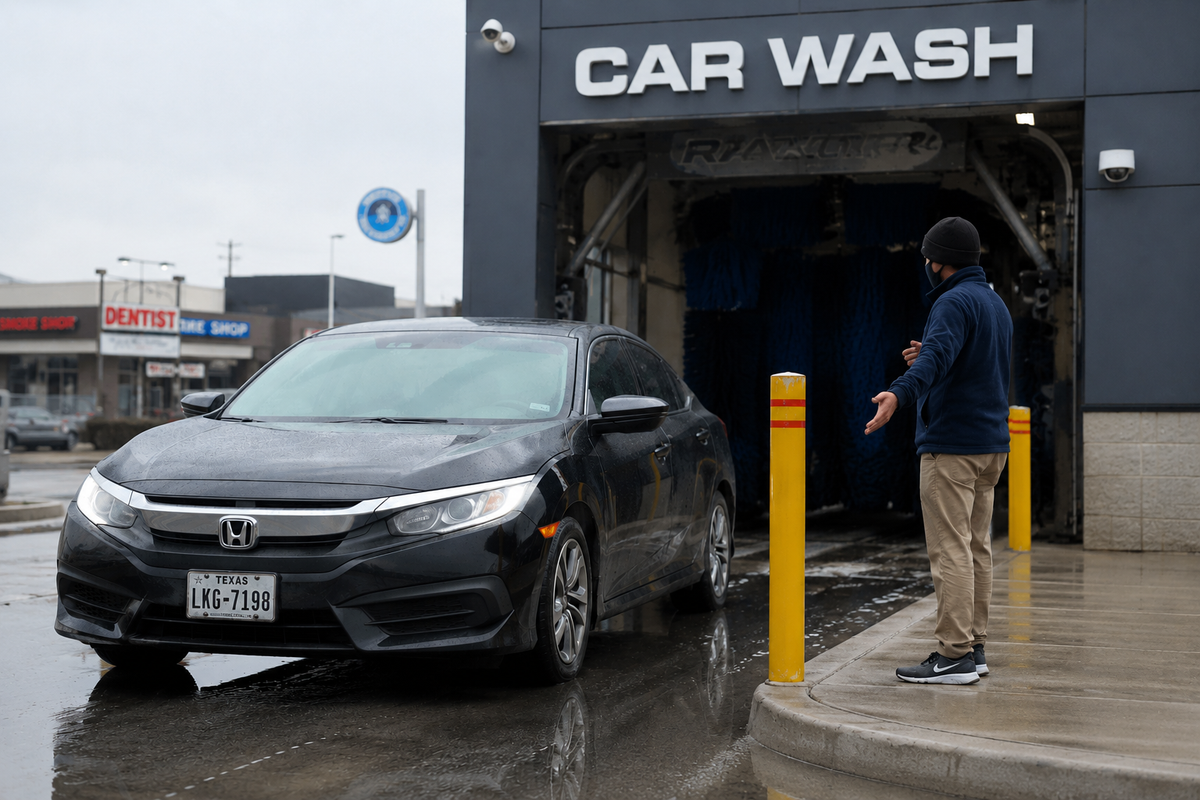
A car wash garage door opener should match the door’s size, weight, lift arrangement, peak operating cycles, and exposure to water and chemicals. Horsepower alone does not establish suitability. Start with the door and wash-bay conditions, then have an installer confirm the exact operator, controls, and protection devices for that environment.
Replacing an opener or equipping a new wash bay requires checking the available electrical or compressed-air infrastructure. Request a quote that identifies the work needed for the proposed drive and mounting arrangement.
For a broader overview of configurations, see our guide to choosing a commercial garage door opener. The checks below focus on the additional requirements of a car wash.
Record the door specifications before choosing horsepower
Give the installer the door width and height, construction, weight if documented, and the manufacturer’s identification. Photograph the tracks, shaft, available mounting space, and current operator label. Include any changes planned for the door, such as replacing its panels or converting its lift arrangement.
LiftMaster’s commercial buyer’s guide identifies door style, size, weight, and cycle needs as selection factors. Its recommendation to involve a professional installer is especially relevant when an existing wash bay has equipment close to the door’s travel or mounting area.
Source: LiftMaster Commercial Door Operators Buyer’s Guide.
Have the door’s operating condition checked as part of the assessment. A difficult-to-move door needs its cause identified before motor capacity is selected. Ask the installer to document the chosen horsepower and the manufacturer’s capacity limits for your particular door and lift configuration.

Size operating capacity for the busiest hour
A garage door opener duty cycle describes its permitted operating frequency or running time under specified conditions. Use the selected model’s definition and limits. Manufacturer ratings may state cycles per hour, cycles per day, or another duty specification; a spring’s lifetime cycle rating answers a different question.
Record how often each door opens and closes during peak business, along with the daily total. Include staff movements and any wash sequence that opens the same door more than once. Count the entrance and exit doors separately when their operating patterns differ.
For example, if one door completes an open-and-close cycle for every vehicle and the peak hour handles 18 vehicles, the starting requirement is 18 cycles in that hour. Add any other actual movements before comparing the requirement with the operator’s rating. This is an illustrative counting method, not a recommended equipment capacity.
Ask the supplier to confirm both the hourly and daily requirements, the operating conditions behind the rating, and any rest periods. Avoid choosing from labels such as light duty or heavy duty alone: the numeric limits belong to the exact model.
Confirm suitability for water and chemical exposure
Describe where spray reaches the operator and controls, which cleaning products are used, and whether condensation or freezing conditions occur. A motor in a protected equipment room faces a different exposure from a unit mounted inside the wash bay. The proposed location belongs in the equipment specification.
Airlift Doors describes an EMAXX system with corrosion-resistant motor components and a NEMA 4X controller enclosure. Safe-Way’s CDJ-WD washdown operator page separately lists a NEMA 4X electrical enclosure and waterproof photo-eyes. These are examples of component-specific specifications, not proof that every commercial operator suits a wash bay.
Ask which parts of the quoted system carry the stated protection rating and whether the manufacturer approves the actual exposure. The enclosure, operator, connections, controls, and sensors must be considered together. A protected control box alone does not establish that an entire installation can be directly sprayed.
Sources: Airlift Doors openers and controls and Safe-Way CDJ-WD washdown operators.
Compare pneumatic and electric operation for the bay
A pneumatic garage door opener uses compressed air to move the door. An electric operator uses an electric motor, with the required power and controls determined by the selected system. Either proposal needs documented compatibility with the door and the wash environment.
|
Decision |
Pneumatic proposal |
Electric proposal |
|---|---|---|
|
Available infrastructure |
Confirm the specified air supply, capacity, air treatment, and routing. |
Confirm supply voltage, phase, controller requirements, and routing. |
|
Operating speed |
Request opening and closing times for the actual door and air supply. |
Request opening and closing times for the actual door and drive configuration. |
|
Service planning |
Identify air-system and operator service tasks and replacement parts. |
Identify motor, drive, controller, and protection-device service tasks. |
|
Existing installation |
Check what can be reused and what the conversion requires. |
Check compatibility before retaining existing wiring, controls, or mounting. |
Compare the complete installation cost and service scope. Do not assume one drive type is always faster, cheaper, or longer-lasting: door configuration and the particular equipment affect the result. A pneumatic sensing edge is a detection component and does not make an electric opener an air-powered system.
Source: American Garage Door Supply’s comparison of air-powered and electric wash-bay operators.
Check jackshaft and trolley mounting against the door
The jackshaft vs. trolley garage door opener decision starts with the door’s lift arrangement and available space. A jackshaft configuration drives the door shaft; a trolley configuration moves the door through a rail and connecting arm. The exact mounting and permitted door types vary by model.
In a wash bay, ask the installer to show how the proposed equipment fits around wash machinery, overhead services, and the moving door. If relocating the motor to a drier position is proposed, require confirmation that the arrangement is permitted for the selected equipment. Mounting style alone does not determine moisture resistance or duty capacity.
Our commercial opener guide for warehouses and fleets explains the general configurations. Use the manufacturer’s current documentation to confirm whether a particular model is appropriate for your wash bay.
Ask for an itemized operator and controls proposal
Ask the installer or supplier to identify the following in writing:
-
Door specifications, mounting arrangement, and the exact operator model and motor version.
-
Peak and daily operating requirements, expected travel times, and applicable duty limits.
-
Approved environmental exposure and protection of the complete equipment package.
-
Electrical or compressed-air work, wash-controller integration, and manual operation provisions.
-
Compatible protection devices, commissioning, maintenance responsibilities, and exclusions.
Have the installer distinguish devices that command the door to open from devices intended to protect the closing path. Confirm their compatibility with the chosen operator and include functional testing in the handover. Keep the model information, current manuals, and service contact with the site records.
Share the door details, photographs, peak operating count, and exposure conditions with All Security Equipment when reviewing commercial door operators. Confirm the exact package’s suitability with your installer and the manufacturer before ordering.
Car Wash Garage Door Openers FAQs
Can an electric garage door opener be used in a car wash?
Yes, when the exact system is approved for the door and the wash-bay environment. Check the motor, controller, connections, and protection devices; a moisture-resistant component does not establish suitability for the entire installation.
How much horsepower does a car wash door opener need?
There is no single horsepower requirement for every car wash. The installer must match the door’s type, dimensions, weight, lift arrangement, and operating frequency to the selected manufacturer’s capacity limits.
Should I replace an electric opener with a pneumatic operator?
Compare the existing door, available air supply and electrical service, environmental approval, speed, and service requirements. Ask for the complete conversion scope before deciding which components can be reused.