Skip to content

Modern facilities rely on clear communication to guide vehicles and people safely. Parking garages, drive-through lanes, warehouses, and industrial properties all depend on signage to control traffic and provide instructions.
Traditional signs can only display fixed messages. When conditions change, the sign stays the same.
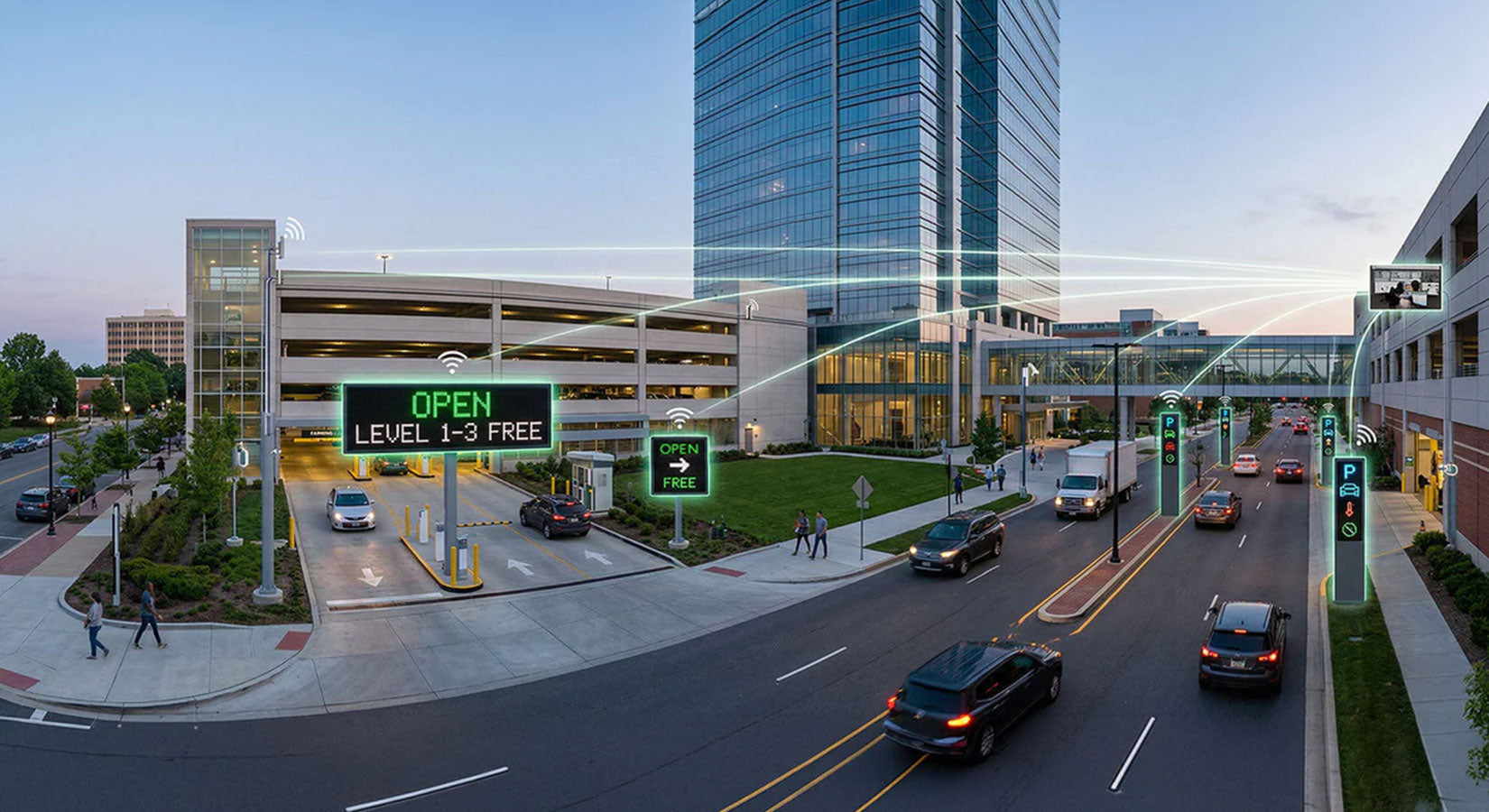
A smart sign system solves this problem by allowing signs to update messages automatically or through centralized controls. These systems use digital signage, LED displays, and automated controllers to communicate information in real time.
Smart sign systems help organizations improve traffic flow, increase safety, and manage operations more efficiently.
What Is a Smart Sign System?
A smart sign system is a digital signage network that allows facilities to control and update signs electronically.
Instead of using static printed signs, smart signs display dynamic messages using LED technology. Operators can change these messages through software, switches, or automated triggers.
This allows signs to display real-time information such as:
-
Open or closed lanes
-
Parking availability
-
Directional arrows
-
Safety warnings
-
Operational instructions
Because messages can change instantly, facilities can respond quickly to traffic conditions or operational needs.
The Core Components of a Smart Sign System
A smart sign system typically includes several key components that work together.
LED Sign Displays
LED displays form the visible part of the system. These signs are bright, durable, and designed to be readable in both daylight and low-light environments.
LED signs are commonly used to display:
-
Directional arrows
-
Lane status indicators
-
Warning messages
-
Parking instructions
Their brightness and high contrast make them easy for drivers to see from a distance.
Control Systems
Control systems manage how the signs operate.
Some systems use physical switches or relay controls, while others rely on centralized software platforms that manage multiple signs at once.
Centralized control allows facility managers to:
-
Change messages instantly
-
Schedule automatic updates
-
Coordinate signage across multiple locations
-
Respond quickly to operational changes
Sensors and Automated Triggers
Many smart sign systems include sensors that activate signs automatically.
For example, a sensor may trigger a warning sign when a vehicle approaches a loading dock. In parking garages, sensors can detect vehicle movement and activate directional guidance signs.
Automation helps reduce manual oversight and ensures the system responds immediately to real-world conditions.
Where Smart Sign Systems Are Used
Smart signage can be found in many industries where traffic flow and communication are important.
Parking Facilities
Parking garages and large parking lots often use smart signs to direct drivers toward available spaces.
Digital signage can show:
-
Open parking levels
-
Available spaces
-
Directional arrows to empty sections
This reduces congestion and prevents drivers from circling the garage searching for parking.
Bank Drive-Through Lanes
Banks were among the earliest adopters of smart sign systems.
Lane control signs allow banks to display messages such as:
-
OPEN
-
CLOSED
-
NEXT LANE
These signs help drivers quickly identify which lane to use, reducing wait times and improving traffic flow.
Industrial Facilities
Warehouses and industrial properties use smart signage to improve safety and manage vehicle movement.
Common uses include:
-
Loading dock warnings
-
Truck direction signs
-
Equipment operation alerts
-
Restricted area warnings
These signs help workers and drivers stay aware of changing conditions.
Transportation and Infrastructure
Smart signage is also used in transportation systems such as:
-
Highway traffic control
-
Pedestrian crossings
-
Light rail signals
-
Service lane management
In these environments, quick communication is essential for both safety and efficiency.
Why LED Technology Is Essential
LED technology plays a major role in modern smart sign systems.
Unlike printed signs, LED displays remain visible in almost any lighting condition. They are also highly durable and designed for long operating lifespans.
Key advantages of LED signage include:
-
High brightness and contrast
-
Visibility in direct sunlight
-
Long LED life spans
-
Low maintenance requirements
-
Energy-efficient operation
Because LED signs are easy to see and highly reliable, they are ideal for traffic guidance and safety communication.

Signal-Tech: A Leader in Smart Sign Systems
Founded in 1928, Signal-Tech began as a manufacturer of custom neon displays and large advertising signs.
In the 1950s, the company introduced one of the first drive-through lane control systems for financial institutions. This innovation helped banks manage customer traffic more efficiently.
Over the years, Signal-Tech expanded into digital signage and smart sign systems used in a wide range of industries.
Today, the company produces signage solutions for:
-
Parking guidance systems
-
Bank drive-through lanes
-
Industrial facilities
-
Highway and transportation signage
-
Pedestrian safety systems
-
Workplace warning signage
Signal-Tech products are known for their durability, high visibility, and industry-leading warranties.
You can explore available signage and control devices in the Signal-Tech collection, which includes parking signs, LED indicators, and automated traffic control solutions.
Why Smart Sign Systems Are Becoming More Important
As facilities grow larger and vehicle traffic increases, managing movement efficiently becomes more challenging.
Static signs cannot adapt to changing conditions, but smart sign systems can.
By using digital signage, centralized control, and automation, these systems help organizations:
-
Improve traffic flow
-
Reduce congestion
-
Increase safety
-
Communicate instructions clearly
-
Manage operations more efficiently
For businesses that rely on organized traffic and clear communication, smart sign systems are quickly becoming an essential part of modern infrastructure.