Skip to content


Your automatic gate operator stops working. Do you need an entirely new operator, or just a replacement part?
In many cases, a problem with an automatic gate doesn’t mean the complete operator needs to be replaced.
Gate operators are made up of multiple mechanical and electrical components. Depending on the manufacturer and model, components such as control boards, motors, batteries, limit components, chains, sprockets, covers, gears, transformers, and other parts may be available separately.
The key is determining what’s actually causing the problem before ordering anything.
This guide explains common gate operator replacement parts, symptoms that may indicate a repair is possible, and when replacing the complete gate operator may make more sense.
Safety Note: Automatic gate operators contain moving components, electrical equipment, and systems capable of producing significant force. Disconnect and service equipment only according to the manufacturer’s instructions. Repairs involving electrical components, stored energy, moving gate hardware, or entrapment-protection systems should be performed by qualified professionals when appropriate.
Repair or Replace a Gate Operator?
Start with the age of the operator, its overall condition, and the actual component that failed.
A newer commercial gate operator with one failed replaceable component is a very different situation from an old operator with multiple mechanical and electrical problems.
Before deciding, consider:
- Operator age
- Overall condition
- Availability of replacement parts
- Cost of the repair
- Number of existing problems
- Gate condition
- Frequency of use
- Parts compatibility
- Current installation requirements
- Whether the manufacturer still supports the model
The first step is diagnosing the problem.
Don’t Replace the Operator Before Checking the Gate
The operator isn’t always the problem.
An automatic gate operator is designed to move a properly functioning gate. If the gate itself is difficult to move, replacing the operator may not solve anything.
Before assuming the operator has failed, inspect the gate for problems such as:
- Damaged hinges
- Worn rollers
- Bent track
- Obstructions
- Damaged wheels
- Misalignment
- Chain problems
- Excessive resistance
For a slide gate, inspect the track, wheels, guide rollers, and other supporting hardware.
For a swing gate, inspect hinges, pivot points, brackets, alignment, and the gate’s overall movement.
If the gate is mechanically binding, that problem should be addressed before installing a new operator.
1. Gate Operator Control Boards
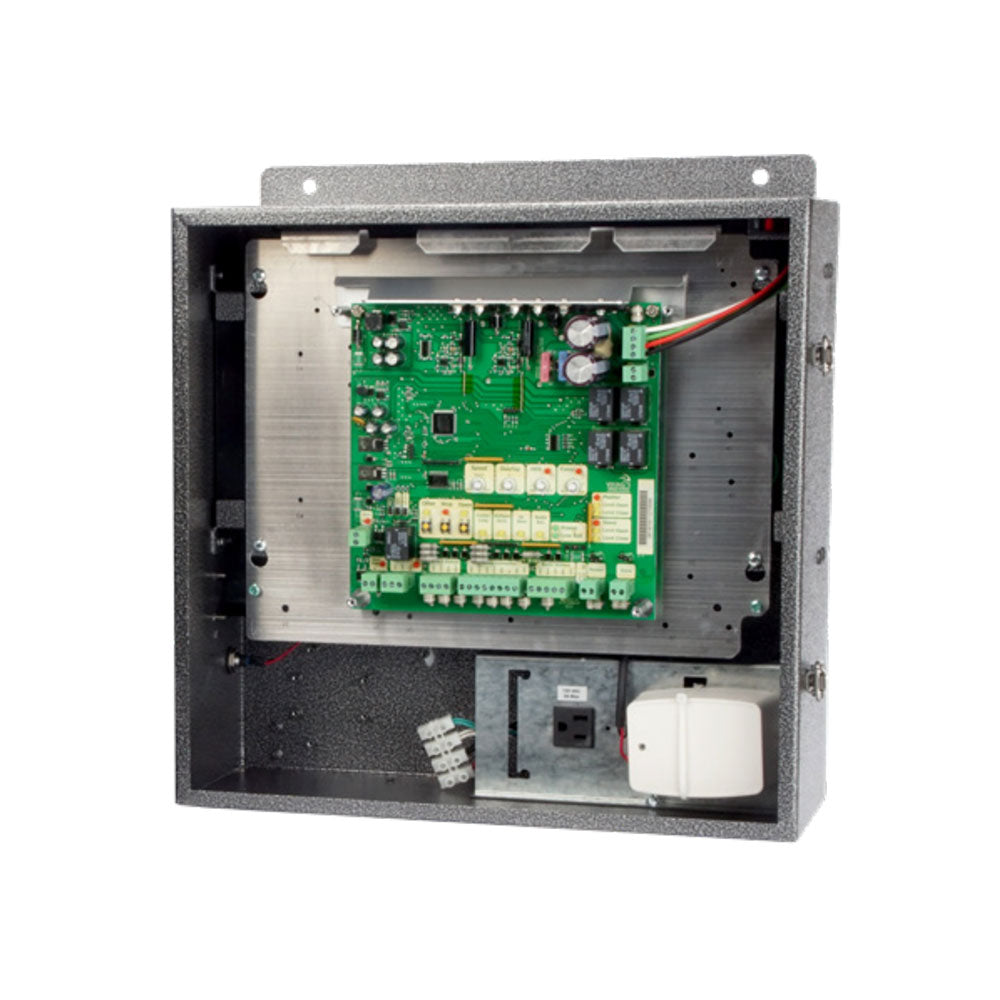
The control board is essentially the central electronic controller of the gate operator.
Depending on the model, it can manage functions such as:
- Open and close commands
- Limits or position information
- Safety-device inputs
- Access-control inputs
- Timer-to-close
- Vehicle detection inputs
- Operator diagnostics
- Accessory connections
Because so many devices connect to the control board, it’s easy to blame it whenever the gate doesn’t work.
But a control board should not automatically be the first component replaced.
Symptoms That May Look Like a Control Board Problem
Possible symptoms can include:
- Operator doesn’t respond to commands
- Gate behaves inconsistently
- Accessories aren’t responding correctly
- Diagnostic faults appear
- Inputs don’t behave as expected
- Operator doesn’t complete normal cycles
The important word is may.
Those same symptoms can also result from:
- Power problems
- Weak batteries
- Wiring
- Safety devices
- Access-control equipment
- Vehicle detectors
- Limits
- Motors
- External accessories
Before Buying a Control Board
Check the operator’s diagnostic information and follow the manufacturer’s troubleshooting procedure.
If a replacement board is required, verify the exact operator model and board part number.
A control board that looks similar isn’t necessarily compatible.
Shop Gate Operator Control Boards
2. Gate Operator Batteries
Batteries are a common service item in many DC and battery-backup gate operator systems.
Over time, batteries lose their ability to store and deliver power effectively.
Possible signs of a battery or charging problem can include:
- Slow gate movement
- Inconsistent operation
- Reduced operation during an outage
- Operator fails under load
- Battery-related diagnostic codes
- Solar gate performance declining
However, don’t assume every power problem is caused by the battery.
The issue could also involve:
- Charger
- Transformer
- Wiring
- Connections
- Solar panel
- Power supply
- Control board
Replace the Battery or the Operator?
A failed battery by itself generally isn’t a reason to replace an otherwise functional gate operator.
If the operator is still supported and operating correctly after the power issue is addressed, battery replacement can be a much smaller repair.
Always use batteries that meet the specifications required by the operator manufacturer.
Shop Gate Operator Batteries
3. Gate Operator Motors
The motor provides the mechanical power needed to move the gate.
Motor problems can produce symptoms such as:
- Operator receives a command but doesn’t move correctly
- Unusual motor noise
- Motor runs inconsistently
- Gate movement becomes weak
- Operator stops under load
But before replacing the motor, check the gate.
A motor that appears weak may actually be trying to move a gate with:
- Damaged rollers
- Binding hinges
- Debris in the track
- Incorrect alignment
- Excessive resistance
Replacing a motor without correcting the mechanical problem can leave you with the same symptoms—or place unnecessary strain on the new component.
When Can Motor Replacement Make Sense?
If the operator is otherwise in good condition, the correct motor is still available, and diagnostics confirm the motor has failed, replacing it may be more practical than replacing the entire operator.
Shop Gate Operator Motors & Replacement Parts
4. Limit Switches, Magnets and Position Components
The operator needs to know where the gate should stop.
Depending on the model, gate position can be determined using components such as:
- Limit switches
- Limit nuts
- Magnets
- Encoders
- Position sensors
- Electronic travel systems
When something goes wrong with the position system, you may see symptoms such as:
- Gate stops too early
- Gate doesn’t fully open
- Gate doesn’t fully close
- Operator travels farther than expected
- Gate reverses unexpectedly
- Limit-related diagnostic faults
Before replacing parts, follow the limit-setting or position-learning procedure for the exact operator.
The issue may be adjustment or programming rather than a failed component.
Shop Gate Operator Limit & Position Components
5. Chains and Sprockets
Slide gate operators commonly use chains and sprockets to transfer motion from the operator to the gate.
These are mechanical components and can wear over time.
Inspect for:
- Excessive chain wear
- Damaged links
- Corrosion
- Improper tension
- Worn sprocket teeth
- Alignment problems
- Damaged mounting hardware
A worn drive component doesn’t necessarily mean the complete slide gate operator needs replacement.
If the operator itself is functioning correctly, replacing worn chain or sprocket components may restore proper mechanical operation.
Don’t Ignore the Cause of the Wear
If a chain or sprocket wears prematurely, look beyond the damaged part.
Check:
- Gate alignment
- Chain alignment
- Gate resistance
- Hardware condition
- Installation geometry
Replacing the worn component without correcting the underlying problem may lead to another failure.
Shop Gate Chains, Sprockets & Hardware
6. Gears and Internal Drive Components
Depending on the operator design, gears and other internal mechanical components may transfer motor power through the drive system.
Wear or damage can result in:
- Unusual noises
- Motor running without proper gate movement
- Irregular operation
- Mechanical slipping
- Failure to transfer motion
Availability of individual internal parts varies significantly by manufacturer and operator.
Before disassembling the operator, determine whether the manufacturer offers the component separately and whether the repair is appropriate for the model.
7. Gate Operator Covers and Enclosures
Not every replacement part affects gate movement.
Operator covers and enclosure components protect internal equipment from environmental exposure and accidental contact.
A damaged cover can expose equipment to:
- Rain
- Dirt
- Debris
- Insects
- Physical damage
If the operator works correctly but the cover is cracked, missing, or damaged, replacing the enclosure component may be much more practical than replacing the entire operator.
Make sure the replacement cover matches the exact operator model.
Shop Gate Operator Covers & Enclosures
8. Transformers, Chargers and Power Components
Power problems don’t always mean the main control board has failed.
Depending on the operator, the electrical system can include:
- Transformers
- Battery chargers
- Power supplies
- Fuses
- Wiring harnesses
- Other power components
If an operator isn’t receiving or maintaining the correct power, diagnosing the power system can identify whether an individual component needs replacement.
For solar installations, also consider:
- Solar panel condition
- Shading
- Wiring
- Battery condition
- Charging performance
- Accessory power consumption
A power-system diagnosis can prevent replacing expensive components unnecessarily.
9. Receivers and Remote-Control Components
Sometimes the gate operator works perfectly, the problem is simply how you’re trying to activate it.
If the gate works from one control method but not another, investigate the command device.
For example:
Gate works from keypad but not remote
This points troubleshooting toward the remote/receiver system rather than immediately toward the operator.
Check:
- Remote battery
- Remote programming
- Receiver power
- Receiver wiring
- Antenna
- Compatibility
- Relay output
Remote Compatibility Matters
A replacement remote isn’t compatible simply because it has the same brand name.
Compatibility can depend on:
- Receiver model
- Frequency
- Radio technology
- Operator generation
- Programming method
Identify the receiver before purchasing replacement transmitters.
Shop Gate Remotes & Receivers
10. Gate Operator Arms, Brackets and Mechanical Components
Swing gate systems introduce another group of replacement parts.
Depending on the operator, service components may include:
- Operator arms
- Mounting brackets
- Pivot components
- Hardware
- Actuator components
If a bracket is bent or damaged, don’t simply replace it and continue operating the gate.
Determine why it failed.
Possible underlying causes can include:
- Incorrect installation geometry
- Gate misalignment
- Mechanical binding
- Physical impact
- Gate stops
- Excessive forces
The new component should not be expected to compensate for an unresolved installation problem.
11. Safety Devices Aren’t Necessarily Operator Parts
A gate that refuses to close can make it seem like the operator has failed.
But the actual problem may be an external safety device.
Examples include:
- Photo eyes
- Safety edges
- Wireless edge equipment
- Associated wiring
Depending on the operator and fault condition, a safety-device problem can prevent normal gate operation.
That means a customer could potentially spend hundreds of dollars replacing operator components when the actual problem is elsewhere.
Diagnose the complete system before purchasing a control board or complete operator.
Shop Gate Photo Eyes & Safety Edges
12. Vehicle Detection Can Also Look Like an Operator Problem
Vehicle detection is another system that can influence gate operation.
Depending on the installation, this can include:
- Inductive loops
- Loop detectors
- Probe sensors
- Magnetometers
- Radar detectors
If a detection input remains active when it shouldn’t, the gate may behave differently than expected.
Again, the operator may simply be responding to an external input.
Check the system before assuming an internal operator component has failed.
Shop Vehicle Detection Equipment
How to Find the Correct Gate Operator Replacement Part
Once you’ve identified the failed component, there is another challenge:
finding the correct replacement.
This is where model and part identification becomes critical.
Step 1: Find the Operator Manufacturer
Common gate operator manufacturers include brands such as:
- LiftMaster
- FAAC
- BFT
- Viking Access
- DoorKing
- Nice
- Linear
- HySecurity
- Maximum Controls
The manufacturer immediately narrows down the search.
Step 2: Find the Exact Model Number
Don’t stop at:
“It’s a LiftMaster slide gate operator.”
You need the specific model.
Different models—and sometimes different generations of the same product family—can use different components.
Look for the operator’s identification label or documentation.
Step 3: Find the Part Number
If possible, identify the existing component’s part number.
Part numbers can appear on:
- Control boards
- Motors
- Covers
- Labels
- Packaging
- Manuals
- Exploded parts diagrams
Searching by the exact part number is often one of the fastest ways to locate a replacement.
Step 4: Check Revision and Compatibility
Some replacement parts supersede older components.
Others only work with certain production dates, revisions, or operator generations.
Read compatibility information carefully before ordering.
What Information Should You Have Before Contacting ASE?
If you’re not sure which part you need, gather as much information as possible before contacting our team.
The most useful information includes:
Operator Brand
For example: LiftMaster, BFT, FAAC, Viking Access.
Exact Model Number
Photograph the operator label if necessary.
Part Number
If visible on the existing component.
Symptoms
Describe exactly what happens.
Instead of:
“My gate is broken.”
Tell us:
“The operator receives an open command, the motor runs, but the gate doesn’t move.”
The more specific the symptom, the easier it is to narrow down the system.
Diagnostic Codes
If the operator displays an error or diagnostic code, write it down.
Photos
Photos of the operator, label, existing part, wiring connections, or damaged component can be useful for identification.
When Does Repairing a Gate Operator Make Sense?
Repair can make sense when:
- The failed component has been clearly identified
- A compatible replacement part is available
- The rest of the operator is in good condition
- The operator is still supported
- The repair cost is reasonable compared with replacement
- There aren’t multiple major problems
- The operator remains appropriate for the gate and application
For example, replacing a failed battery, cover, receiver, or compatible control component can be much more practical than replacing an otherwise functional operator.
When Should You Consider Replacing the Complete Gate Operator?
There comes a point where repeatedly repairing an old operator may no longer make sense.
Consider complete replacement when:
- Critical replacement parts are discontinued
- Multiple major components are failing
- The operator has extensive corrosion or physical damage
- Repair costs are approaching the cost of replacement
- The operator is no longer appropriate for the gate
- The existing system cannot support the installation’s current needs
- The manufacturer no longer supports the equipment
Age alone doesn’t automatically determine whether an operator should be replaced.
The important question is its overall condition, supportability, safety, and repair economics.
Repair vs. Replace: Quick Comparison
|
Situation |
Repair May Make Sense |
Replacement May Make Sense |
|---|---|---|
|
Weak battery |
✓ |
|
|
Damaged cover |
✓ |
|
|
Failed compatible receiver |
✓ |
|
|
Single replaceable component failed |
✓ |
|
|
Replacement parts discontinued |
✓ |
|
|
Multiple major failures |
✓ |
|
|
Extensive physical damage |
✓ |
|
|
Operator no longer suitable for gate |
✓ |
|
|
Repair cost approaching new equipment |
✓ |
|
|
Gate itself has mechanical problems |
Repair gate first |
Don’t assume operator replacement will solve it |
Avoid the Parts Cannon
There’s a common troubleshooting approach that gets expensive quickly:
Replace parts until the problem disappears.
Control board didn’t fix it?
Replace the motor.
Still doesn’t work?
Replace the batteries.
That isn’t efficient troubleshooting.
A better approach is:
Symptom → Diagnostics → External Devices → Mechanical Gate → Power → Wiring → Component Testing → Replacement
Identify the problem first.
Then buy the part.
Frequently Asked Questions
Can a gate opener be repaired?
Yes. Many automatic gate operators have individual replacement components available. Repairability depends on the operator model, failed component, parts availability, and overall condition of the system.
How do I know what gate operator replacement part I need?
Start with the operator manufacturer and exact model number. Then identify the symptom, diagnostic code, and part number if available. Use the manufacturer’s documentation to confirm compatibility.
Should I replace the control board if my gate won’t open?
Not automatically. A gate that won’t open can have problems involving power, batteries, wiring, access-control inputs, safety equipment, mechanical hardware, the motor, or other components. Diagnose the system before replacing the board.
Is it worth repairing an old gate operator?
It depends on parts availability, overall condition, repair cost, and whether the operator remains appropriate for the installation. An older operator with one available replacement component may still be repairable, while an unsupported system with several major failures may be a better candidate for replacement.
Can I replace a gate operator battery myself?
Battery replacement procedures vary by operator. Follow the manufacturer’s instructions, use the specified battery type, and observe electrical and battery safety requirements. Contact a qualified technician if you’re unsure.
Why is my gate motor running but the gate isn’t moving?
Possible causes can include drive-system problems, chain or sprocket issues, mechanical gate resistance, internal components, or other failures. Inspect the system rather than assuming the motor itself needs replacement.
Can I use a different control board if it looks the same?
Do not determine compatibility by appearance. Verify the manufacturer’s part number, operator model, revision, and compatibility information before installing a replacement control board.
Where can I find my gate operator model number?
Look for the manufacturer’s identification label on or inside the operator enclosure. The exact location varies by manufacturer. The operator’s manual may also help identify where model and serial information is located.
Find Gate Operator Replacement Parts at All Security Equipment
A broken automatic gate doesn’t always require a new operator.
The solution may be a:
Control Board | Battery | Motor | Chain | Sprocket | Limit Component | Cover | Receiver | Power Component | Mechanical Part
The important part is determining what actually failed.
At All Security Equipment, you’ll find gate operator replacement parts from leading manufacturers for residential, commercial, and industrial automatic gate systems.
Find the Right Part Before You Replace the Operator
Already have the part number?
Search All Security Equipment by part number or operator model to find compatible gate operator replacement parts.
Not sure what you need?
Contact the All Security Equipment team with the manufacturer, model number, diagnostic code, symptoms, and photos of the existing equipment. We’ll help you identify compatible replacement parts for your gate operator.