Skip to content

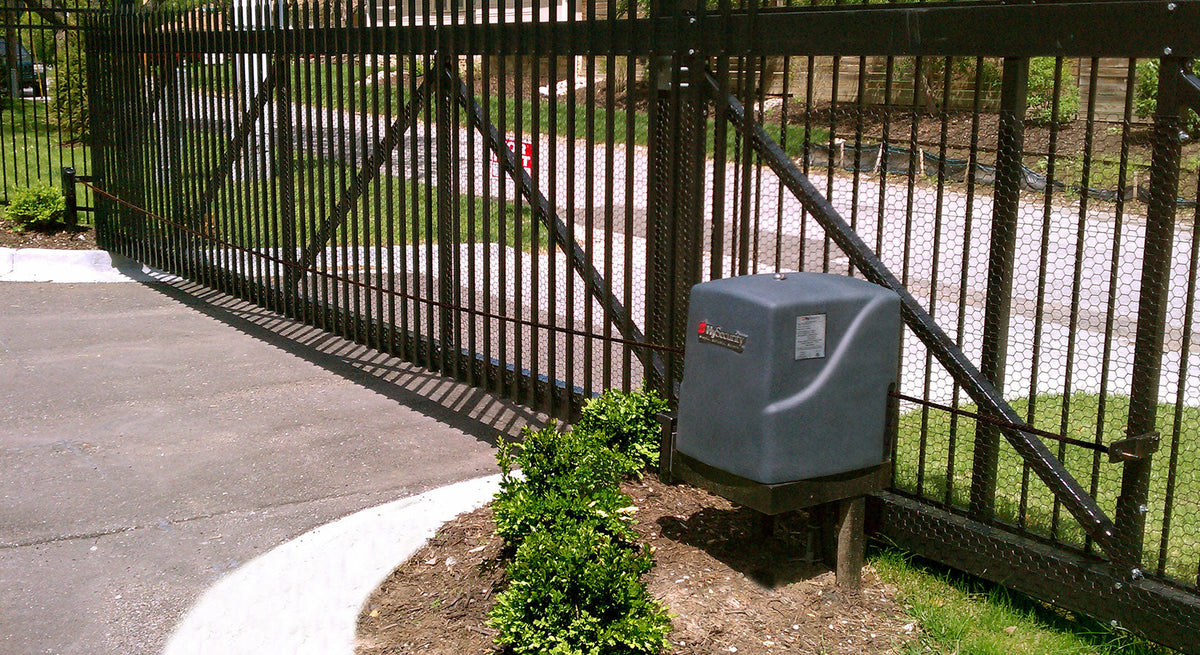
What happens to your automatic gate when the power goes out?
For homeowners, a power outage can mean losing convenient access to their driveway. For commercial properties, it can interrupt vehicle traffic, deliveries, and daily operations.
That’s why gate operator battery backup systems are an important consideration when choosing or maintaining an automatic gate opener.
A battery backup system can allow a compatible gate operator to continue operating when utility power is unavailable. However, not every gate operator includes battery backup, and not every backup system provides the same performance.
Some operators have built-in battery backup capabilities. Others require additional components, while certain systems use batteries as part of their normal operating power architecture.
Understanding these differences is essential when selecting a new gate operator or replacing an existing battery.
In this guide, we’ll explain how automatic gate battery backup works, compare common battery types, discuss replacement considerations, and help you determine which equipment is appropriate for your installation.
What Is a Gate Operator Battery Backup?
A gate operator battery backup is a power system that allows a compatible automatic gate operator to operate using stored electrical energy when its primary power source becomes unavailable.
Under normal conditions, the system may receive power from a building’s electrical supply.
When utility power fails, the operator can use energy stored in its batteries, provided the system is designed and configured for backup operation.
A simplified arrangement looks like this:
Utility Power → Gate Operator Power System → Battery Charging
During a power outage:
Backup Battery → Gate Operator → Gate Movement
The exact configuration depends on the operator.
Some systems automatically transition to battery operation, while others use batteries as their primary DC power source and recharge them whenever external power is available.
Why Is Battery Backup Important for Automatic Gates?
Automatic gates are often installed at locations where reliable access is essential.
Examples include:
- Residential driveways
- Gated communities
- Apartment complexes
- Commercial parking areas
- Warehouses
- Industrial facilities
- Storage properties
- Private roads
When electrical power is interrupted, a gate without an appropriate backup arrangement may stop operating automatically.
A compatible battery backup system can help maintain access during temporary outages.
Residential Convenience
Homeowners may need to enter or leave their property during storms or utility interruptions.
Battery backup can allow continued automatic operation without immediately relying on manual release procedures.
Commercial Operations
Businesses may need to maintain access for employees, customers, deliveries, and service vehicles.
A power outage that disables the entrance can create delays and operational problems.
Gated Communities
Residential communities may have frequent vehicle traffic throughout the day.
Battery backup can help maintain access while utility service is being restored.
Emergency Access Planning
Battery backup may support an emergency access strategy, but it should not be considered a substitute for required emergency access equipment or procedures.
Emergency access requirements depend on the installation and local authorities.
How Does a Gate Operator Battery Backup System Work?
The operating sequence depends on the electrical design of the gate operator.
However, most battery-supported systems involve three basic components:
- A power source
- A battery or battery bank
- A charging and power management system
Normal Operation
When utility power is available, the operator receives the electrical power needed for normal operation.
Depending on the design, the system may also maintain the battery’s charge.
Power Outage
When utility power becomes unavailable, a battery-capable operator may continue operating using stored energy.
The number of available gate cycles depends on several factors, including battery capacity, battery condition, gate load, and accessory consumption.
Power Restoration
When electrical power returns, the charging system can begin replenishing the battery.
The time required to restore the battery’s charge depends on the charger, battery specifications, and level of discharge.
Do All Automatic Gate Openers Have Battery Backup?
No.
Battery backup availability varies by manufacturer, operator model, and configuration.
Some gate operators include batteries or backup capability as part of their design.
Others require batteries to be purchased separately.
Certain operators may not support battery backup without additional manufacturer-approved equipment.
Before purchasing a gate opener, verify:
- Whether battery backup is supported
- Whether batteries are included
- Required battery voltage
- Required battery capacity
- Charging system specifications
- Backup operating limitations
Browse automatic gate openers and operators to explore equipment for residential and commercial applications.
AC vs. DC Gate Operators: What’s the Difference?
Understanding the difference between AC and DC gate operators can help explain why battery backup capabilities vary.
AC Gate Operators
AC gate operators use an AC-powered motor or drive system.
Depending on the model, they may require a dedicated backup power solution to continue operating during an outage.
An AC-powered operator does not automatically support battery backup simply because a battery is connected to its control board.
The backup system must be specifically designed for that operator.
DC Gate Operators
DC gate operators use a DC-powered motor.
Many DC operators are designed to operate with battery-supported power systems.
Depending on the model, the batteries may provide backup power or serve as part of the normal operating power arrangement.
However, not every DC gate operator includes batteries or provides the same backup capabilities.
AC vs. DC Gate Operator Comparison
|
Feature |
AC Gate Operator |
DC Gate Operator |
|---|---|---|
|
Motor power |
Alternating current |
Direct current |
|
Battery backup |
Model-dependent |
Common on compatible designs |
|
Batteries included |
Model-dependent |
Model-dependent |
|
Backup operation |
Requires approved configuration |
Depends on operator design |
|
Solar compatibility |
Model-dependent |
Available on selected systems |
|
Typical applications |
Residential and commercial |
Residential and commercial |
Important: Motor voltage alone doesn’t determine whether an operator has battery backup. Always verify the exact model’s power system.
Types of Batteries Used in Gate Operators
Automatic gate operators use different battery technologies depending on their electrical requirements.
Common options include:
- Sealed lead-acid batteries
- Absorbent glass mat (AGM) batteries
- Gel batteries
- Lithium-based batteries in specifically designed systems
The correct replacement depends on the manufacturer’s requirements.
1. Sealed Lead-Acid Batteries
Sealed lead-acid batteries are commonly used in automatic gate applications.
They are often selected because they provide rechargeable power in a relatively compact format.
These batteries are available in different voltage and capacity ratings.
For example, some gate operators use 12V batteries, while others use multiple batteries connected to provide the required system voltage.
2. AGM Batteries
AGM stands for Absorbent Glass Mat.
AGM is a type of valve-regulated lead-acid battery that uses a fiberglass separator to hold the electrolyte.
AGM batteries are commonly used in standby and backup power applications.
Potential advantages include:
- Sealed construction
- Low routine maintenance
- Rechargeable operation
- Availability in different capacities
However, AGM batteries must still be compatible with the operator’s charging system.
3. Gel Batteries
Gel batteries are another type of sealed lead-acid battery.
They use a gelled electrolyte and have specific charging requirements.
A gel battery should not automatically be substituted for an AGM battery unless the charging system and manufacturer specifications support it.
4. Lithium Batteries
Some modern power systems use lithium-based battery technology.
Lithium batteries can offer different weight, charging, and cycle-life characteristics compared with lead-acid batteries.
However, a lithium battery should not be used as a direct replacement for a lead-acid gate operator battery unless the manufacturer explicitly approves the substitution.
Battery management, charging voltage, temperature limits, and protection requirements may differ.
What Battery Voltage Does a Gate Operator Need?
Battery voltage is one of the first specifications to verify.
Common configurations include:
- 12V battery systems
- 24V battery systems
- Other manufacturer-specific arrangements
Some 24V systems use two 12V batteries connected in series.
However, the correct arrangement depends on the operator.
Can You Replace a 12V Battery With a 24V Battery?
No, not unless the equipment is specifically designed for that configuration.
Using an incorrect voltage can damage the operator or create electrical hazards.
Always match the manufacturer’s specified battery voltage and configuration.
What Does Ah Mean on a Gate Operator Battery?
Battery capacity is commonly expressed in amp-hours (Ah).
For example:
- 12V 7Ah
- 12V 9Ah
- 12V 18Ah
- 12V 35Ah
These ratings describe battery capacity under specified test conditions.
In general, a battery with a higher Ah rating can store more energy when compared at the same nominal voltage and under comparable conditions.
However, a higher Ah rating doesn’t automatically make a battery compatible with a gate operator.
Other factors include:
- Physical dimensions
- Terminal type
- Charging system
- Battery chemistry
- Maximum supported capacity
- Manufacturer requirements
Does a Higher Ah Battery Last Longer?
Potentially, but the answer depends on the application.
A higher-capacity battery may support more operation during an outage if the system is designed to use it.
However, installing a larger battery can also affect charging time and may exceed the operator manufacturer’s approved specifications.
Choose the capacity recommended for the operator.
How Long Will a Gate Opener Run on Battery Backup?
There is no universal number of gate cycles available from a backup battery.
Runtime depends on several variables.
Battery Capacity
A battery with greater usable capacity may provide more stored energy.
Battery Condition
An aging battery may provide significantly less usable capacity than a new one.
Gate Weight and Length
A heavier or larger gate may require more energy to operate.
Gate Condition
A gate with worn hinges, damaged rollers, or excessive friction can place additional demands on the operator.
Temperature
Extreme temperatures can affect battery performance.
Accessory Power Consumption
Connected accessories may continue drawing power during an outage.
Frequency of Operation
A gate that opens and closes frequently will consume stored energy faster than one used occasionally.
Standby Consumption
Even when the gate isn’t moving, the operator and connected electronics may consume power.
For these reasons, battery backup performance should be evaluated using the manufacturer’s specifications rather than assuming a fixed number of cycles.
How to Estimate Gate Operator Battery Backup Needs
When evaluating backup power, consider both operating demand and standby consumption.
For example, a residential driveway may experience relatively few gate cycles per day.
A commercial entrance may experience substantially more traffic.
The commercial installation may require a different backup strategy.
Start by identifying:
- Expected gate cycles during an outage
- Approximate outage duration
- Operator power requirements
- Battery specifications
- Connected accessory loads
The manufacturer may provide backup cycle estimates or recommended battery configurations.
Those specifications are the best starting point.
Gate Operator Battery Backup vs. Solar Power
Battery backup and solar-powered gate operation are related, but they are not the same thing.
A battery backup system stores energy for use when the primary power source is unavailable.
A solar-powered gate system uses solar panels to generate electrical energy that can charge a compatible battery system.
Battery Backup
Utility Power → Charger → Battery
The battery supports operation when utility power is interrupted.
Solar Gate System
Solar Panel → Charge Controller → Battery → Gate Operator
The solar panel replenishes stored energy when sufficient sunlight is available.
Comparison
|
Feature |
Battery Backup |
Solar Gate System |
|---|---|---|
|
Primary energy source |
Usually utility power |
Solar energy |
|
Battery storage |
Yes, when configured |
Commonly required |
|
Works during utility outage |
On compatible systems |
Can operate independently of utility power |
|
Requires solar panel |
No |
Yes |
|
Charging depends on sunlight |
No |
Yes |
|
Best application |
Backup for powered installations |
Compatible solar or off-grid installations |
A solar gate operator may also be connected to utility power in certain configurations.
The correct setup depends on the equipment.
Can You Add Solar Panels to an Existing Gate Operator?
Sometimes.
Certain gate operators are designed to support solar charging.
Others are not.
Before purchasing solar equipment, verify:
- Operator compatibility
- Required solar panel specifications
- Charge controller requirements
- Battery capacity
- Daily gate usage
- Accessory power consumption
- Available sunlight
Don’t assume that connecting a solar panel to an existing battery will create a compatible solar gate system.
What Happens When a Gate Operator Battery Dies?
The symptoms depend on the operator’s design.
Possible signs of a weak or failed battery include:
- Gate stops operating during power outages
- Reduced backup operation
- Battery-related fault messages
- Low-voltage warnings
- Inconsistent operation
- Failure to maintain charge
In battery-dependent systems, a failed battery may also affect normal operation even when utility power is available.
However, these symptoms can have other causes.
A charging system problem, damaged wiring, or excessive mechanical load may produce similar behavior.
How Do You Know When a Gate Operator Battery Needs Replacement?
Common warning signs include:
Reduced Backup Runtime
The gate operates for fewer cycles during an outage than it previously did under similar conditions.
Battery Fault Notifications
The control board may display a battery warning or diagnostic code.
Failure to Hold a Charge
The battery loses usable charge despite receiving appropriate charging power.
Physical Damage
Swelling, leakage, cracks, or other visible damage may indicate a battery problem.
Do not continue using visibly damaged batteries.
Age and Service History
Rechargeable batteries gradually lose capacity.
Their useful life depends on battery chemistry, operating temperature, charging conditions, and usage.
A battery may require replacement even if it appears normal externally.
How Often Should Gate Operator Batteries Be Replaced?
There is no universal replacement interval.
Some sealed lead-acid batteries used in standby applications may require replacement after several years, but actual service life varies significantly.
Factors that affect lifespan include:
- Heat exposure
- Deep discharges
- Charging conditions
- Battery quality
- Frequency of operation
- Maintenance
- Environmental conditions
Follow the operator and battery manufacturers’ inspection and replacement recommendations.
How to Choose a Replacement Gate Operator Battery
The safest and most reliable approach is to start with the operator’s exact model.
Step 1: Identify the Gate Operator
Record:
- Manufacturer
- Model number
- Control board information, if applicable
Step 2: Check the Original Battery Specifications
Look for:
- Voltage
- Amp-hour capacity
- Chemistry
- Physical dimensions
- Terminal configuration
Step 3: Review the Operator Manual
Confirm the approved replacement battery specifications.
Step 4: Verify Battery Configuration
Determine whether the operator uses:
- One battery
- Two batteries
- A larger battery bank
- A manufacturer-specific battery assembly
Step 5: Confirm Physical Fit
The replacement must fit the designated battery compartment or approved enclosure.
Step 6: Check Charging Compatibility
Make sure the replacement is compatible with the operator’s charging system.
Step 7: Replace Batteries According to Manufacturer Instructions
If the system uses multiple batteries, follow the manufacturer’s recommendations regarding matched batteries and replacement procedures.
Can You Use a Larger Battery in a Gate Operator?
Not automatically.
A larger battery may have more capacity, but that doesn’t mean it is suitable for the operator.
Potential concerns include:
- Charging limitations
- Physical space
- Terminal compatibility
- Battery chemistry
- Wiring requirements
- Manufacturer restrictions
Some manufacturers support optional higher-capacity battery configurations.
Others specify particular replacement batteries.
Always follow the approved configuration.
Should You Replace Both Batteries in a 24V Gate Operator?
When a system uses two 12V batteries connected in series, manufacturers may recommend replacing them together.
This helps maintain consistency between the batteries.
Mixing batteries with different ages, capacities, or conditions can create performance problems.
Follow the manufacturer’s instructions for the specific system.
Gate Operator Battery Charging Problems
A battery that repeatedly loses charge may not be the only problem.
Possible causes include:
- Faulty charger
- Damaged wiring
- Loose connections
- Incorrect battery type
- Excessive accessory consumption
- Battery deterioration
- Solar charging problems
- Utility power issues
Replacing the battery without identifying the underlying cause may not solve the problem.
If the charging system is malfunctioning, a new battery may also fail prematurely.
Why Is My Gate Operator Battery Not Charging?
Start by reviewing the operator’s diagnostic information and manufacturer instructions.
Possible causes include:
No Charging Power
The charger may not be receiving the required input power.
Faulty Charging Equipment
A damaged charger or charging circuit may prevent proper battery charging.
Damaged Connections
Loose, corroded, or damaged connections can interfere with charging.
Incorrect Battery
A battery with incompatible specifications may not charge correctly.
Battery Failure
An aged or damaged battery may no longer accept or retain a charge.
Solar System Issues
In solar applications, insufficient sunlight, panel problems, or charging system faults may reduce charging performance.
Electrical troubleshooting should be performed according to the manufacturer’s instructions and by qualified personnel when appropriate.
Gate Operator Battery Backup for Commercial Properties
Commercial gate installations often have different power requirements from residential systems.
A warehouse entrance, gated community, or commercial parking facility may experience frequent gate operation throughout the day.
When selecting backup power for these applications, consider:
- Daily traffic volume
- Peak operating periods
- Gate weight
- Operator duty rating
- Expected outage duration
- Accessory power consumption
- Emergency access requirements
A backup system suitable for a lightly used residential gate may not provide adequate operation for a high-traffic commercial entrance.
Does Battery Backup Power Gate Accessories?
Not necessarily.
A gate operator’s battery backup system may support the operator itself without providing sufficient power for every connected accessory.
Accessories may include:
- Keypads
- Card readers
- Photoelectric sensors
- Wireless receivers
- Intercoms
- Cameras
- Magnetic locks
- Vehicle detection equipment
Some accessories can operate from compatible operator accessory outputs.
Others require separate power supplies.
For example, cameras, video intercoms, and magnetic locks commonly require their own power arrangements.
When planning backup operation, evaluate the complete access control system.
A gate that can move during an outage is only part of the solution. The equipment required to authorize and safely control that movement must also remain operational.
Battery Backup and Emergency Gate Access
Power outages can occur during storms and other emergencies.
Battery backup may help maintain gate operation, but emergency access planning should also account for:
- Local emergency access requirements
- Approved emergency access devices
- Manual release procedures
- Fire department access
- System behavior during power failure
The appropriate configuration depends on the property and applicable requirements.
Do not assume that battery backup alone satisfies emergency access obligations.
Can You Manually Open a Gate During a Power Outage?
Many automatic gate operators include a manual release mechanism.
This may allow the gate to be moved manually when automatic operation is unavailable.
However, the release procedure differs by operator.
Before attempting manual operation:
- Consult the operator manual
- Follow the manufacturer’s instructions
- Keep people clear of the gate’s travel path
- Avoid forcing a damaged or obstructed gate
Heavy or improperly balanced gates can be hazardous.
If the gate cannot be moved safely, contact a qualified gate technician.
Gate Operator Battery Maintenance Tips
Routine inspection can help identify battery problems before they interrupt gate operation.
Inspect the Battery Compartment
Look for signs of moisture, corrosion, or physical damage.
Check Battery Connections
Connections should be secure and maintained according to the manufacturer’s instructions.
Monitor Diagnostic Warnings
Investigate battery-related fault messages promptly.
Test Backup Operation
Follow the operator manufacturer’s recommended procedure for testing battery backup.
Maintain the Gate Mechanism
A gate that moves smoothly can reduce unnecessary strain on the operator.
Inspect Solar Components
For solar-powered systems, check the condition of the panels and related equipment according to manufacturer guidance.
Follow Battery Replacement Recommendations
Replace batteries when they no longer meet the required performance or condition standards.
Common Gate Operator Battery Backup Mistakes
Assuming Every Gate Opener Includes Batteries
Some operators support battery backup but require batteries to be purchased separately.
Buying the Wrong Voltage
Battery voltage must match the approved system configuration.
Choosing Batteries Based Only on Amp-Hours
Capacity is important, but chemistry, dimensions, terminals, and charging compatibility also matter.
Mixing Old and New Batteries
This can create performance problems in multi-battery systems.
Ignoring Accessory Power
The gate operator may have backup power while the intercom or access controller does not.
Using an Unapproved Battery Chemistry
Different battery technologies can have different charging and protection requirements.
Overlooking Gate Condition
A gate with mechanical problems can place additional demands on the operator and battery.
Assuming Solar and Battery Backup Are Identical
Solar systems require compatible charging equipment and adequate energy generation.
Gate Operator Battery Backup Buying Checklist
Before purchasing a replacement battery or backup system, confirm the following.
Gate Operator
- Manufacturer
- Exact model
- AC or DC motor
- Battery backup compatibility
- Manufacturer-approved battery specifications
Battery
- Voltage
- Amp-hour capacity
- Chemistry
- Dimensions
- Terminal type
- Number of batteries required
Power System
- Utility-powered or solar?
- Charger compatibility
- Backup operation requirements
- Available accessory power
- Charging limitations
Application
- Residential or commercial?
- Gate weight and length?
- Daily gate cycles?
- Expected outage duration?
- Connected accessories?
- Emergency access requirements?
Maintenance
- Existing battery condition?
- Charging system condition?
- Battery compartment condition?
- Replacement procedure?
- Manufacturer maintenance recommendations?
Frequently Asked Questions
Do automatic gate openers have battery backup?
Some do, but not all. Battery backup availability depends on the operator model and configuration. Certain operators include batteries, while others require additional equipment.
How long does a gate opener battery backup last?
Backup operation depends on battery capacity, battery condition, gate load, accessory consumption, and frequency of use. Check the manufacturer’s specifications for the specific operator.
What battery does a gate opener use?
Many gate operators use rechargeable sealed lead-acid batteries, including AGM types. However, voltage, capacity, chemistry, and configuration vary by model.
Can I use any 12V battery in my gate opener?
No. The replacement must meet the operator manufacturer’s requirements for chemistry, capacity, dimensions, terminals, and charging compatibility.
What does Ah mean on a gate opener battery?
Ah stands for amp-hours, a measure of battery capacity under specified conditions. A higher Ah rating generally indicates greater capacity at the same nominal voltage, but it doesn’t guarantee compatibility.
Can I install a higher-capacity battery?
Only if the operator manufacturer supports that configuration. A larger battery may not fit or may exceed the charging system’s specifications.
How do I know if my gate opener battery is bad?
Possible signs include reduced backup operation, battery fault messages, failure to hold a charge, or visible physical damage. Charging system problems can produce similar symptoms.
How often should gate operator batteries be replaced?
Replacement intervals vary with battery type, operating conditions, and usage. Follow the manufacturer recommendations and replace batteries when their condition or performance is no longer acceptable.
Will my automatic gate work during a power outage?
It may continue operating if it has a compatible, functional backup power system. Otherwise, manual release or another approved access procedure may be required.
Can I add battery backup to an existing gate operator?
Possibly. Some operators support manufacturer-approved backup equipment, while others do not. Verify compatibility before purchasing components.
Is a solar gate opener the same as a battery backup gate opener?
No. A solar gate system uses solar energy to recharge batteries, while a battery backup system typically stores energy for use when another primary power source is unavailable.
Can solar panels charge my gate opener battery?
Yes, when the operator and charging system are designed for solar operation. The solar panel, charge controller, battery, and operator must be compatible.
Does battery backup power my gate keypad and intercom?
Not automatically. Accessory backup depends on the complete electrical system. Some devices may require separate backup power.
Can I open my automatic gate manually if the battery dies?
Many operators include manual release mechanisms, but the procedure varies. Follow the manufacturer’s instructions and avoid forcing the gate.
Should I replace both batteries in a 24V gate operator?
If the system uses two 12V batteries, manufacturers may recommend replacing them together. Follow the instructions for your specific operator.
Find Gate Operators and Replacement Parts at All Security Equipment
A reliable automatic gate system depends on more than the operator itself.
The battery, charging system, gate mechanism, and connected accessories all affect how the system performs during normal operation and power outages.
When choosing a replacement battery or planning a backup system, start with:
Operator Model → Battery Specifications → Charging Compatibility → Expected Usage → Accessory Requirements
At All Security Equipment, you’ll find automatic gate operators, replacement parts, and accessories for residential and commercial applications.
Explore our selection of:
Need Help Finding a Compatible Gate Operator Battery?
Whether you’re replacing an existing battery or selecting a new gate operator with backup capabilities, compatibility is essential.
Contact the All Security Equipment team with your gate operator manufacturer, model number, and existing battery specifications. Our team can help you explore compatible replacement parts and power solutions for your installation.