Skip to content

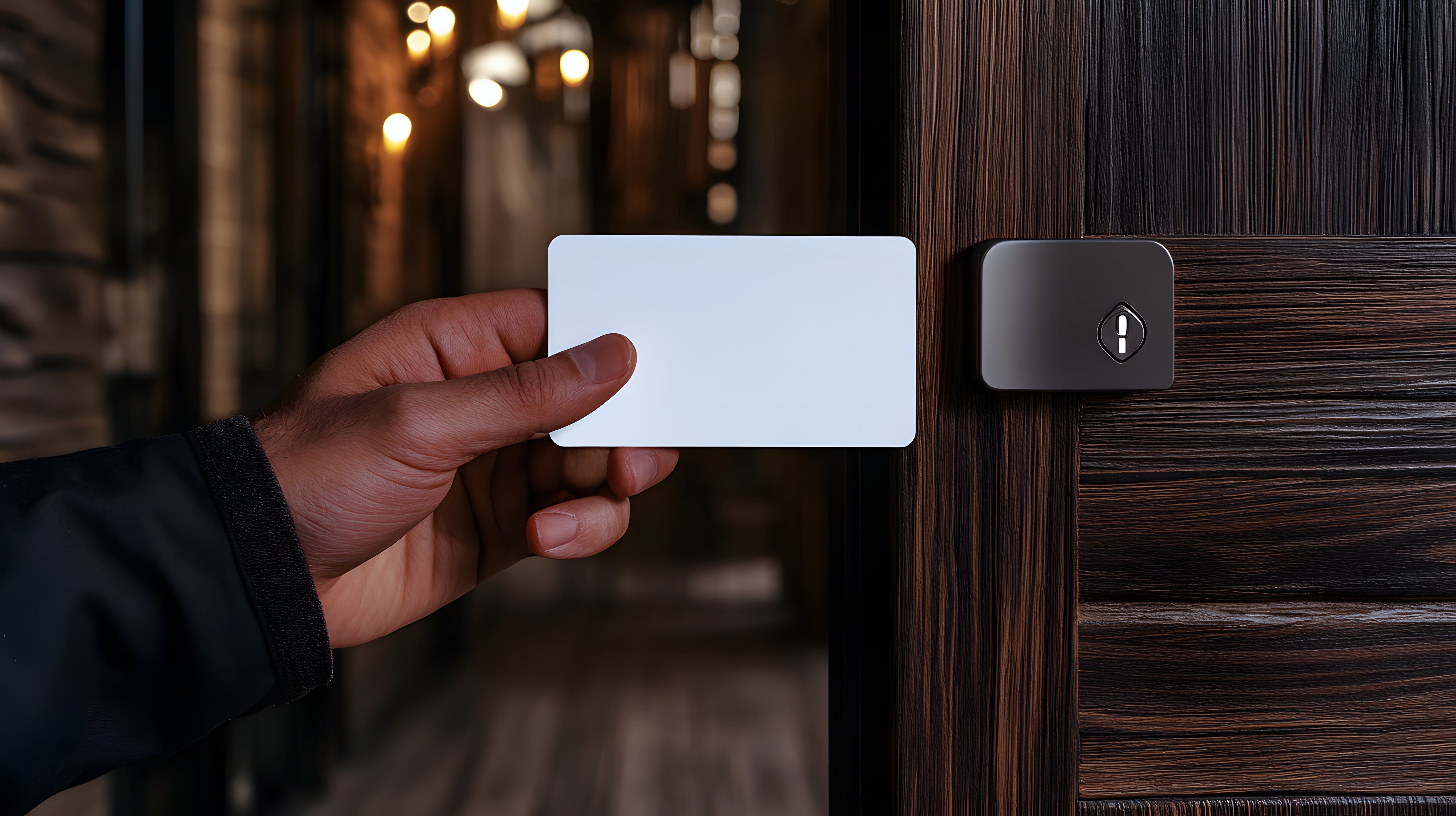
Most access control conversations are about credentials. Card or fob, phone or fingerprint. Almost nobody asks about the wire between the reader and the panel, which is a shame, because on a lot of sites that wire is the weakest thing in the building.
Wiegand sends your card number down two data lines with no encryption at all. OSDP encrypts the same traffic and checks if the reader is still there. Here is what separates them, what the swap costs, and how to move across without ripping everything out.

What the two protocols actually are
One is a signaling method from the 1970s that became a habit. The other is a current, maintained standard.
-
Wiegand is a one-way electrical signaling scheme. The reader pulses two data lines, conventionally green for Data0 and white for Data1, and the panel counts the pulses to reconstruct the card number. The panel cannot talk back, cannot tell whether the reader is still connected, and cannot verify that the data came from a real reader.
-
OSDP, the Open Supervised Device Protocol, is a two-way protocol that runs over an RS-485 bus, the two-wire industrial wiring standard. The panel polls the reader constantly, the reader answers, and OSDP Secure Channel encrypts the conversation with AES-128. HID Global, Mercury Security and Lenel created it in 2008. The Security Industry Association took ownership in 2012, and the International Electrotechnical Commission approved it as an international standard in May 2020, published as IEC 60839-11-5:2020.
The standard is still moving. SIA published OSDP version 2.2.2 in October 2024 and runs a conformance program called SIA OSDP Verified, so you can check a device rather than trust a datasheet. Their OSDP standard page is the authoritative reference if you want the full specification history.
The security gap that started the migration
Wiegand was designed when the threat model was somebody copying a key. Its weaknesses are not bugs, they are just consequences of a 1970s design.
-
The card number travels in the clear. Anyone who reaches the wiring behind a reader can read every credential that passes and replay it later. The reader is on the unsecured side of the door, which is exactly where that wiring is easiest to reach.
-
The panel cannot tell the reader is gone. Cut the cable, unplug the reader, substitute a device of your own, and a Wiegand panel reports nothing. Silence and idle look identical to it.
-
There is no authentication in either direction. The panel believes whatever arrives on those two wires.
OSDP closes all three. Secure Channel encrypts the traffic, constant polling means a disconnected or tampered reader raises an alarm within seconds, and AES-128 is a requirement in federal government applications rather than an option. If you are specifying for a public sector site, this is usually where the decision gets made for you.
Wiegand vs. OSDP at a glance
|
What you are comparing |
Wiegand |
OSDP |
|
Direction |
Reader to panel only |
Both ways, panel polls the reader |
|
Encryption |
None |
AES-128 with Secure Channel |
|
Supervision |
None, a cut cable looks like an idle reader |
Constant, alarms within seconds |
|
Conductors |
12 or more on a full install |
Two for data, plus power |
|
Readers per run |
One reader, one home run |
Multiple devices daisy-chained on one bus |
|
Distance |
Around 500 feet in practice |
RS-485 is specified to 4,000 feet |
|
Reader feedback |
Separate wires for LED and buzzer |
Sent over the same two data wires |
|
Standard |
A de facto convention, no owner |
IEC 60839-11-5:2020, maintained by SIA |
Wiring is where the money actually is
The security argument gets all the attention, but on a real install the wiring is what changes your budget. SIA puts it plainly: OSDP uses two wires where a fully featured Wiegand reader needs twelve or more.
That difference compounds. Wiegand wants a home run from every single reader back to the panel. Each one carries power, two data lines, and separate conductors for the LED, the buzzer, the tamper and the hold. OSDP puts several readers on one RS-485 bus, daisy-chained, so a corridor of four doors shares a single run. On a new building that means less cable, fewer conduit fills, and less labor.
Distance changes too. Wiegand gets unreliable past a few hundred feet, and most manufacturers cap it around 500. RS-485, the physical layer OSDP rides on, is specified out to 4,000 feet. That gap is the difference between a reader at the gatehouse simply working and needing a second panel to reach it.
What switching actually costs
Be honest about this part, because OSDP readers are not a like-for-like price swap.
-
Wiegand readers, roughly $94 to $200: the Security Brands 40-CR2 in plastic is $93.99 and the metal 40-CR1 is $101.99.The ZKTeco KR702E is $142.99, and the EMX waterproof reader and keypad is$200.99.
-
OSDP readers, roughly $400 to $450: the Nedap OSDP reader is $407.99 and the ZKTeco KR500-OSDP proximity reader is $444.99. Call it three to four times the price of the Wiegand equivalent.
-
RS-485 smart card readers from $170.99: the Inner Range SIFER sits between the two tiers and is worth a look if you are already inside that ecosystem.
Set that against the wiring saving. On a new build with a dozen doors, less cable and fewer home runs often cover most of the reader premium. On a retrofit where the cable is already in the walls, it does not, and that is where converters come in.
How to migrate without replacing everything
You do not have to change both ends on the same day, and this is the part almost no comparison article covers.
An inline converter such as the Inner Range 994200 costs $95.99 and works in both directions. Run it one way and existing Wiegand readers plug into an OSDP port, picking up the benefits of the bus behind them. That means a 128-bit AES-encrypted path back to the module, four-core cable, longer runs, and daisy-chaining so several readers share one run. Inner Range rates it for up to 16 Wiegand readers on an access module. Beeper and LED control still work.
Running it the other way, a modern OSDP reader connects to an existing Wiegand reader port, so you can put current hardware on an older panel and defer the panel upgrade. Two sensible paths fall out of that. Replace readers first if the readers are old and the panel is fine, or replace the panel first and convert the readers until budget allows. Either one beats replacing everything at once. Both ends are in our access control range, alongside the credentials that run on them, and the converter itself sits in the Inner Range collection.
When Wiegand is still fine
Nobody needs to panic about every existing reader. The risk is proportional to what is behind the door and how reachable the wiring is.
-
Interior doors past a controlled perimeter: if an attacker already has to badge through a secure entrance to reach the reader's wiring, tapping it is not their easiest option.
-
Gate and intercom stations with the electronics inside the enclosure: where the data lines never leave a locked housing, the exposure is much smaller.
-
Short runs on a small site: a two-door shop with the panel ten feet away gains very little from a bus topology.
Prioritize the other way round. Perimeter doors, gates, parking entrances and anything a member of the public can walk up to should move to OSDP first. Those are the readers whose wiring an outsider can actually reach. The same reasoning drives credential choice, which we cover in mobile credentials versus key cards, and it fits into the wider picture set out in our physical access control guide.
Frequently asked questions
Is OSDP better than Wiegand?
For security, yes, and it is not close. OSDP Secure Channel encrypts reader traffic with AES-128, and the panel polls the reader constantly, so a cut cable or a swapped device raises an alarm. Wiegand sends the card number unencrypted on two data lines. It also cannot tell whether the reader is still there. Wiegand still wins on hardware price, at roughly $94 to $200 per reader against $400 to $450 for OSDP.
Is RS-485 the same as OSDP?
No. RS-485 is the physical layer, meaning the wiring and the electrical signaling. OSDP is the protocol, the language spoken over that wiring. OSDP runs on RS-485, but plenty of other RS-485 devices are not OSDP. A reader described as RS-485 is using the right cable and may still not speak OSDP, so confirm the protocol rather than assuming from the wiring.
How far can OSDP go?
OSDP runs over RS-485, which is specified for cable runs up to 4,000 feet, and multiple readers can be daisy-chained along that bus rather than each needing its own home run. Wiegand becomes unreliable much sooner and manufacturers generally cap it around 500 feet. That gap is often what decides the design on a site with an outbuilding or a gatehouse.
How do I tell whether my reader is Wiegand or OSDP?
Count the conductors at the panel. An OSDP reader typically uses four: two for power and an RS-485 pair for data. A Wiegand reader uses more, usually six or more, because the LED, buzzer, tamper and hold each need their own wire. Wiegand wiring also follows a color convention, green for Data0 and white for Data1. If you see a green and a white data wire, it is Wiegand.
Can I use my existing Wiegand readers with an OSDP panel?
Yes, with an inline converter. The Inner Range 994200 OSDP Wiegand Converter costs $95.99 and connects Wiegand readers to an OSDP port. The run behind it gets a 128-bit AES-encrypted path,four-core cable, longer distances and daisy-chaining. Inner Range rates it for up to 16 Wiegand readers on an access module. The same device also works in reverse, putting an OSDP reader on an existing Wiegand port.
What is OSDP Secure Channel?
It is the encrypted mode of the OSDP protocol, using AES-128 to protect the traffic between reader and panel. It has to be enabled and keyed during commissioning, and that matters. An OSDP reader installed without Secure Channel turned on gives you supervision and two-way communication, but no encryption. Confirm it is active rather than assuming the protocol does it for you.
Start with the readers a stranger can reach
Spending on smarter credentials while leaving unencrypted card data on two wires behind an outdoor reader solves the wrong half of the problem. Move perimeter and public-facing readers to OSDP first. Use converters to stage the rest instead of replacing everything at once, and make sure Secure Channel is switched on before the installer leaves. Interior doors behind a controlled perimeter can wait for their next refresh.