Skip to content

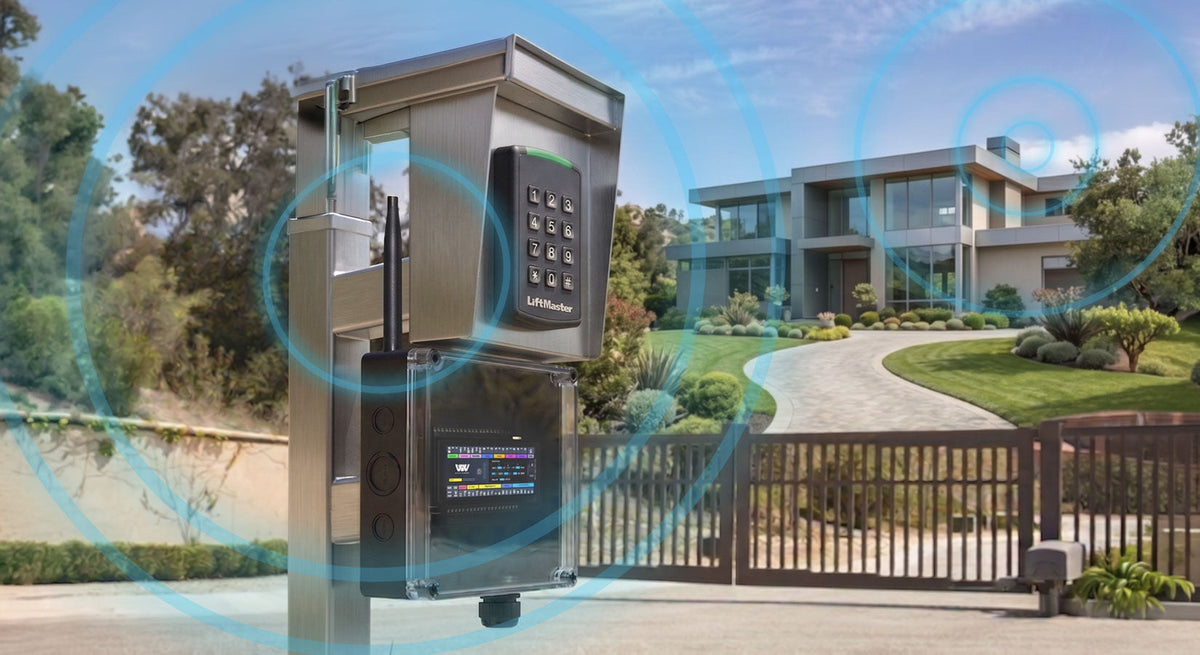
In access control installation, running the wire can sometimes take longer than installing the equipment itself.
A remote gate, parking entrance, elevator, historic building, or existing property can turn what should be a straightforward access control installation into days of trenching, drilling, pulling cable, installing conduit, navigating obstacles, and coordinating additional labor.
The Wireless Wiegand WW-G3 Long-Range Wireless Bridge, available at All Security Equipment, offers another approach.
Instead of physically running communication wiring between remote access control hardware and the main control panel, the WW-G3 creates a secure, long-range wireless bridge between them.
The result? Reduce installation time from days to hours.
What Is the Wireless Wiegand WW-G3?
The Wireless Wiegand WW-G3 is a long-range wireless bridge designed to replace traditional communication cabling between access control devices and a centralized access control panel.
It can wirelessly transmit the low-voltage signals an access control system needs, including card reader data, lock commands, door status information, and other control signals.
The system supports:
- Wiegand
- OSDP
- RS-485
- Relay and dry-contact signals
This means installers can connect access control equipment across difficult locations without having to build a physical communication path between the two points.
From the perspective of the access control equipment, the system continues communicating as expected, the wireless bridge simply replaces the cable between locations.
The Problem Isn’t Always the Access Control System. It’s Getting the Wire There.
Think about a typical remote gate installation.
The access control panel may be inside the main building, while the reader and gate equipment are hundreds or even thousands of feet away.
Traditionally, connecting those two locations could mean:
- Trenching across the property
- Cutting through pavement or concrete
- Installing conduit
- Pulling hundreds or thousands of feet of cable
- Drilling through walls or floors
- Working around existing landscaping
- Coordinating additional contractors
- Obtaining permits for certain types of work
- Repairing surfaces after installation
- Troubleshooting damaged or inaccessible cable
The access control portion of the project may be relatively simple. Getting the wiring from Point A to Point B can become the project.
Wireless Wiegand is designed to eliminate that bottleneck.
Finish the Work in Hours, Not in a Week
Wireless Wiegand describes its technology as providing a setup up to 10x faster than conventional installation methods.
Instead of designing the entire installation around a cable route, installers can establish a wireless connection between the access control panel and the remote hardware.
That can dramatically change the scope of a job.
Rather than spending days dealing with trenching, conduit, drilling, cable pulls, and restoration, an installer can focus on mounting the equipment, supplying local power, establishing the wireless bridge, and completing the access control installation.
For professional security and access control installers, that doesn’t just mean convenience.
It means productivity.
If a crew can complete a difficult access control installation significantly faster, those labor hours can be spent completing other projects instead of pulling wire.
Skip the Trenching
One of the clearest applications for the WW-G3 is any project where trenching would normally be required.
Imagine adding access control to a gate located across a parking lot from the main building.
Running new cable could require opening pavement, installing underground conduit, pulling cable, closing the trench, and repairing the surface.
With the Wireless Wiegand WW-G3, the communication link can be established wirelessly instead.
That makes the technology particularly useful for:
- Parking gates
- Remote vehicle entrances
- Perimeter gates
- Large commercial properties
- Campuses
- Existing facilities
- Properties separated by roads or parking areas
Avoiding a long cable run can potentially eliminate one of the most expensive and time-consuming parts of the installation.
A Powerful Solution for Retrofit Projects
New construction gives installers an opportunity to plan cabling before walls, ceilings, landscaping, and pavement are finished.
Retrofits are different.
Once a building or property is complete, getting new communication cable to the desired location can become significantly more complicated.
You may encounter finished walls, concrete structures, occupied spaces, inaccessible pathways, existing utilities, or architectural restrictions.
Wireless Wiegand provides another way to extend an existing access control system without redesigning the property around a new cable route.
That makes the WW-G3 especially valuable when adding new readers, gates, doors, or controlled areas to an existing system.
When a Buried Cable Fails, Don’t Dig Up the Property
The WW-G3 can also provide an alternative when existing access control wiring fails.
A damaged buried cable can create a difficult choice.
Find the damaged section and excavate it, or replace the entire cable run.
Either option can mean significant labor and downtime.
Instead, a Wireless Wiegand bridge can potentially replace the failed communication run without reopening the original pathway.
For service technicians, keeping this type of solution available can turn a major cable repair into a much more manageable service call.
Go Where Running Cable Isn’t Practical
Some locations aren’t simply expensive to wire. They’re extremely difficult, or sometimes impractical, to wire at all.
Wireless Wiegand identifies several applications where eliminating the physical cable run can provide a major advantage.
Historic Buildings
Drilling, cutting, or modifying historic structures may be restricted or undesirable. Wireless communication allows access control systems to expand while reducing the need to disturb the building.
Elevators
Getting access control communication into elevators can introduce another layer of complexity. A wireless bridge can provide an alternative to traditional communication wiring in appropriate elevator access control applications.
Construction Sites
Temporary gates, entrances, and controlled areas may need access control before permanent infrastructure exists. Installing extensive cabling for something that will eventually move may not make sense.
Temporary Installations
If an access point is only needed temporarily, Wireless Wiegand can make it easier to deploy and later relocate the equipment without abandoning a long cable run.
Remote Gates and Entry Points
Long driveways, perimeter entrances, remote facilities, and large properties can require substantial cable distances. Long-range wireless communication makes these locations much easier to reach.
Long Range Without the Long Cable Run
Eliminating wire wouldn’t mean much if the wireless connection only worked across short distances.
That’s where the WW-G3 becomes particularly interesting.
Wireless Wiegand is engineered for long-range communication and can operate over tens of miles under real-world conditions, depending on the environment, elevation, antenna configuration, and other installation factors.
The system is also designed to maintain communication through walls, floors, and other obstructions found in complex environments.
That opens up possibilities far beyond simply connecting a reader across a room.
It allows installers to think about access control across an entire property without automatically asking:
“How are we going to get a cable all the way over there?”
Designed for Challenging RF Environments
Going wireless introduces another important consideration: interference.
The WW-G3 is designed to operate across 200 dynamic channels, continuously scanning and selecting clearer frequencies to help avoid interference and signal collisions.
If interference or jamming is detected, the system can automatically change channels to help maintain communication.
Additional resiliency features include watchdog timers, automatic restarts, and self-healing protocols designed to recover from connectivity issues without requiring constant manual intervention.
For installers, that means the system isn’t simply focused on achieving distance. It’s designed to maintain a dependable connection in real-world environments where many other wireless signals may already be present.
Secure Wireless Communication for Access Control
Access control data needs to be protected whether it travels through a cable or through the air.
Wireless Wiegand uses AES-based encryption, with the WW-G3 specified for AES-128 encryption, to protect transmitted information.
The system is designed to help protect communication against threats including interception, spoofing, replay attacks, and other attempts to manipulate the wireless connection.
Wireless Wiegand also maintains a supervised connection using continuous heartbeats and real-time link awareness.
Built-in diagnostics, connectivity information, event logging, and monitoring tools give installers greater visibility into the status of the connection.
Wiegand, OSDP, RS-485 and Relay Support
Another major advantage of the WW-G3 is flexibility.
Access control installations don’t all use the same communication method, particularly when installers are working with a combination of older and newer equipment.
The WW-G3 supports multiple communication interfaces, including Wiegand, OSDP/RS-485, and relay signals.
The master device includes two Wiegand ports supporting 4- to 80-bit communication along with RS-485/OSDP connectivity.
That flexibility allows Wireless Wiegand to work across a wide variety of access control applications rather than being limited to one narrowly defined installation.
Built for Installers Who Need to Get the Job Done
For professional installers, the biggest advantage of Wireless Wiegand may not be any individual specification.
It’s what those capabilities can remove from the job.
Less trenching. Less conduit. Less cable. Less drilling. Less disruption. Less time getting from Point A to Point B.
Instead of allowing a difficult cable route to determine the timeline and cost of an access control project, the WW-G3 gives installers another option.
That can be especially valuable when quoting jobs.
A location that previously required extensive infrastructure work may suddenly become a much simpler access control installation.
Wireless Wiegand WW-G3 Kit Options
All Security Equipment offers the Wireless Wiegand WW-G3 in configurations for different project sizes:
- 2-Door Kit – 1 Master Unit + 1 Remote Unit
- 4-Door Kit – 2 Master Units + 2 Remote Units
- 8-Door Kit – 4 Master Units + 4 Remote Units
The kits include the corresponding master and remote units along with antennas. Power supplies and mounting hardware are not included.
The WW-G3 operates on 12 or 24 VDC and can also be USB-powered for site surveys.
Where Does the WW-G3 Make the Most Sense?
Not every access control installation needs to be wireless.
If conduit and cabling are already available, using the existing infrastructure may still be the simplest solution.
The WW-G3 becomes particularly compelling when the cable itself is the problem.
Consider Wireless Wiegand when you’re facing:
- A long-distance cable run
- A remote gate or entrance
- Expensive trenching
- Concrete or pavement between locations
- Historic-building restrictions
- A damaged underground cable
- Elevator access control
- An existing building retrofit
- A temporary access control installation
- A construction site
- A difficult or inaccessible cable pathway
- An installation where traditional wiring would significantly increase labor
In these situations, changing how the signal gets there can completely change the economics and timeline of the project.
Stop Spending Days Running Wire
Access control installers solve complicated problems every day. Running a communication cable shouldn’t turn a straightforward installation into a week-long construction project.
The Wireless Wiegand WW-G3 Long-Range Wireless Bridge gives installers another way to approach those difficult jobs.
Connect remote access control hardware to the main system. Avoid unnecessary trenching and long cable runs. Reduce installation time. Move on to the next project.
Finish the work in hours, not in a week.
The Wireless Wiegand WW-G3 Long-Range Wireless Bridge is available now at All Security Equipment.
Explore the available 2-door, 4-door, and 8-door configurations and find the right setup for your next access control installation.